
Article
How to follow up after applying for a job
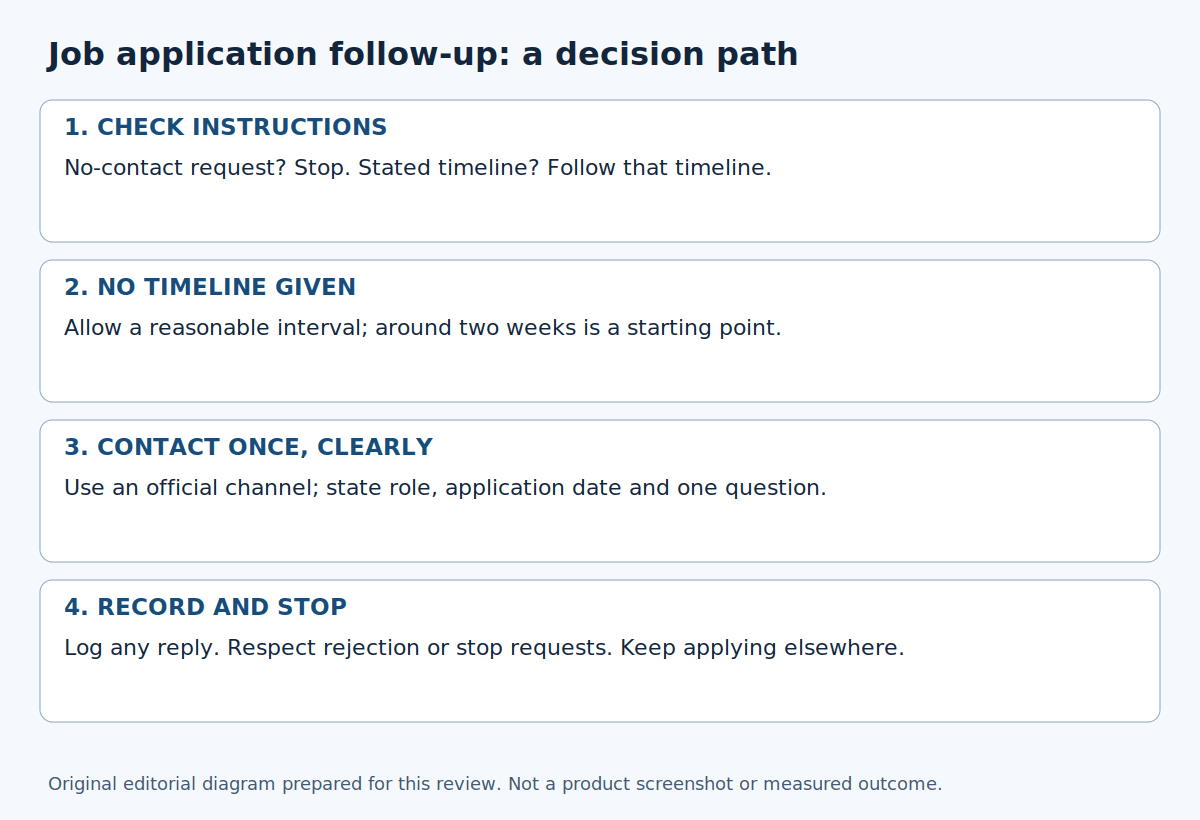
Before you follow up after applying for a job, read the posting and your confirmation email again. The employer may already have given a review date, a status portal or a request not to contact the team. Those instructions matter more than a generic follow-up schedule.
If an enquiry is appropriate, send a short message that identifies your application and asks about the timeline. You are making it easy to find your details, not asking the recruiter to defend the delay. A follow-up cannot guarantee a reply, an interview or a better hiring outcome.
Decide whether to wait or send a message
There is no universal day on which every applicant should follow up. University career services offer different starting points: University of Arizona guidance suggests two weeks after an application, while UNLV guidance suggests about seven to ten days unless the posting gives a timeline. Treat these as suggestions, not employer commitments.
Use the situation to decide:
- A closing date is still ahead: allow time for the review process rather than asking for a decision before applications close.
- A recruiter promised an update: use that date, allowing a reasonable margin before checking in.
- No timeline is available: roughly two weeks can be a starting point for considering one enquiry, if contact is permitted.
- The posting says no calls or no status enquiries: respect the exact restriction. Do not switch channels to evade it.
- You have already interviewed: use the interviewer's update timeline. A thank-you note and a later status enquiry have different purposes.
For an interview thank-you, UNLV suggests writing within about a day. Keep it separate from a request for a hiring decision. Do not turn that suggestion into a requirement for every employer or recruitment process.
Choose one appropriate contact route
Check the application portal first if one is available. It may already contain an update or the instructions for submitting questions. Then look for a recruitment contact in the advert, confirmation message or employer's official careers page.
Email is useful when the employer provides a suitable address. Reply in an existing recruiter thread when that keeps the context clear. Do not send replies to a no-reply mailbox or guess the hiring manager's address.
A brief LinkedIn message may fit an existing conversation with a recruiter who uses it for recruitment. It is not a reason to message several employees. Use the same short content you would send by email, and do not send both on the same day just to increase the chance of attention.
Call only when the employer provides an appropriate number and permits or invites recruitment enquiries. Prepare the job title, application date and one question. If the person cannot help, thank them and use the route they recommend. Repeated calls to unrelated staff will not clarify your application.
Write a message the recruiter can answer
A clear subject line can include the job title and your name: "Application follow-up: [Job Title] - [Your Name]." Include a vacancy reference if the employer uses one. Avoid subjects such as "Urgent" unless there is a real deadline to explain.
In the message, state when you applied and for which role. Add one relevant detail if it helps, then ask one process question. You do not need to repeat your cover letter or describe every qualification. Keep contact details simple and proofread the recipient's name, company and role before sending.
Five short follow-up email options
These are editable draft templates, not messages that have been sent. Replace every placeholder and keep only statements that are true. The additional situations below are alternatives, not a sequence of emails to send to one employer.
1. No update after applying
Subject: Application follow-up: [Job Title] - [Your Name]
Dear [Recruiter's Name],
I applied for the [Job Title] role at [Company] on [Date] and remain interested in the position. My experience with [Relevant Task] relates to the work described in the posting. Could you share the expected timeline for the next stage?
Thank you for your time.
[Your Name]
[Your Email or Phone]
2. After an application deadline
Dear [Recruiter's Name], I applied for [Job Title, Reference] before the [Date] deadline. I remain interested in the role and would appreciate any information you can share about the review timeline. Thank you, [Your Name].
Wait for an appropriate review period after the deadline; this wording does not mean you should contact the employer as soon as applications close.
3. A recruiter conversation has gone quiet
Dear [Recruiter's Name], I am following up on our conversation about [Job Title] on [Date]. I remain interested and wanted to ask whether there is an updated timeline for the next step. Thank you, [Your Name].
Use this only when that conversation actually happened. Do not imply that a recruiter has reviewed your application simply because you received an automated acknowledgement.
4. A stated update date has passed
Dear [Recruiter's Name], You mentioned that an update on the [Job Title] role was expected around [Date]. I remain interested and wanted to ask whether the timeline has changed. Thank you for any update you can share, [Your Name].
5. You have a genuine competing offer
Dear [Recruiter's Name], I remain interested in the [Job Title] role. I have received another offer with a response deadline of [Date]. Could you let me know whether an update on your process may be available before then? I understand if your schedule cannot accommodate that date. Thank you, [Your Name].
Do not invent an offer to create urgency. You can explain a real deadline without naming the other employer, disclosing private offer documents or demanding a faster decision.
Use real evidence even if this is your first job
You can mention coursework, volunteering or a personal project rather than paid experience. Make the context clear. A fictional administrative applicant might write: "My class project involved creating a registration spreadsheet and writing instructions for the team." That is more informative than claiming broad professional expertise.
A fictional worked situation: an applicant submits a CV, receives no review date and finds a permitted recruitment email in the posting. After waiting a reasonable period, they check the portal, send one concise enquiry and record it. If a reply gives a new date, that becomes the next reminder. The example demonstrates a process, not evidence that a recruiter replied or that the applicant was selected.
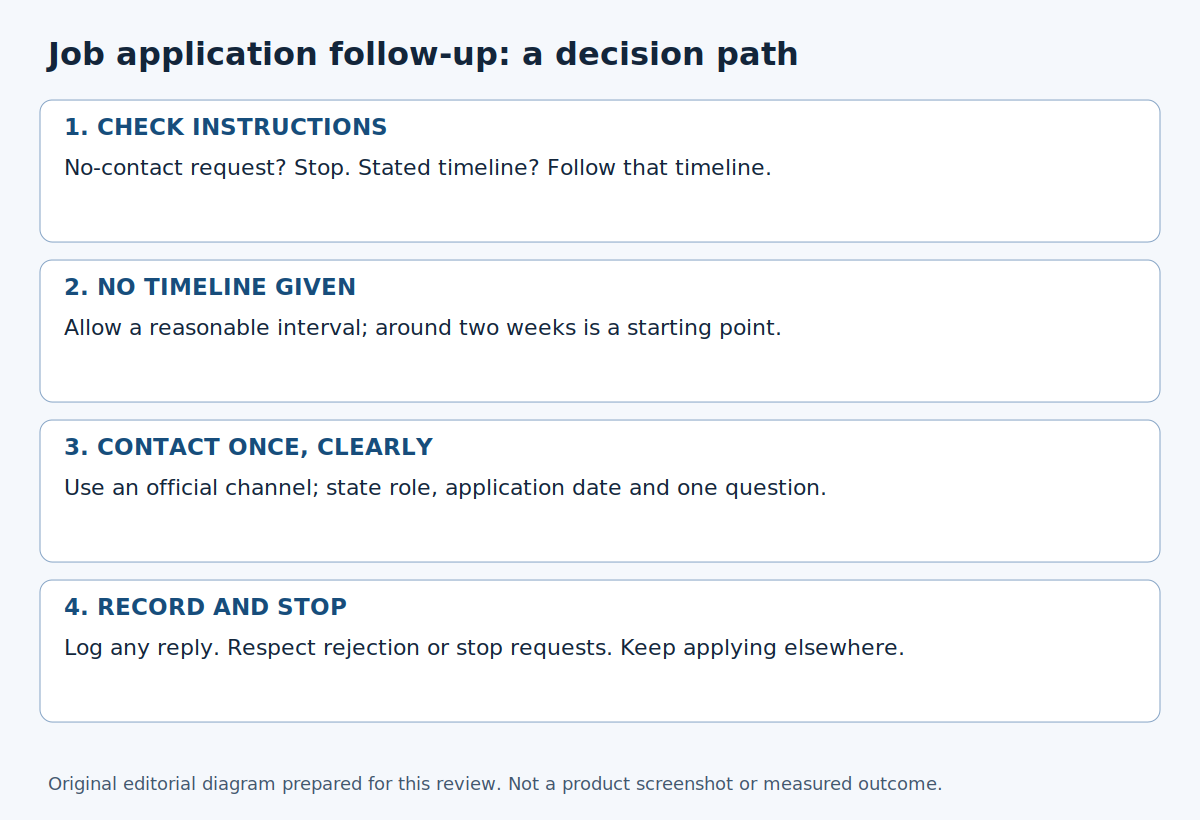
Original explanatory diagram generated for this editorial correction; not a product screenshot. The diagram contains no copied image assets. Source: this article’s worked example. No third-party image licence is asserted.
Keep sensitive information out of the follow-up
Send only enough information to identify the application. Do not attach identity documents, bank details, private references or another person's records to an unsolicited status enquiry. If someone requests more documents, verify the request through the employer's official channel and use the instructed submission route.
A relevant completed course or new project may justify a brief update, but do not attach extra files just to create a reason to write. If the employer asks for a revised CV, check that version before sending it and record which file you supplied.
Record the next action and know when to stop
Keep your own application tracker with company, job title, reference, application date, closing date, stated review timeline, official contact route, last message and current status. Add a next action rather than an automatic schedule of repeated messages.
If there is no reply, waiting longer or sending no further message may be appropriate. Consider a final check-in only when the context warrants it and contact remains permitted. One enquiry is often enough. Silence does not authorize contacting unrelated employees, and it does not tell you exactly what decision has been made.
Stop status enquiries when the employer asks you to stop, confirms rejection, closes the process or you have sent your final reasonable check-in. If you receive a rejection, a brief acknowledgement or optional feedback request may fit an existing conversation; it is not an invitation to argue for reconsideration. Continue other applications while waiting.
Before you press send
- Have you checked the posting, portal and latest recruiter message?
- Does the timing respect the employer's instructions?
- Is this the correct official contact route?
- Have you identified the role and application date accurately?
- Are you asking one clear question?
- Have you removed unnecessary attachments and private information?
- Have you replaced every template placeholder?
- Will you record the message and stop conditions in your tracker?
For your next opportunity, browse ALHarih jobs, read the employer's application instructions and keep your own record of dates and responses. For help preparing the application itself, explore ALHarih articles. A listing does not guarantee availability, a response or a hiring outcome.
Read next
View all articles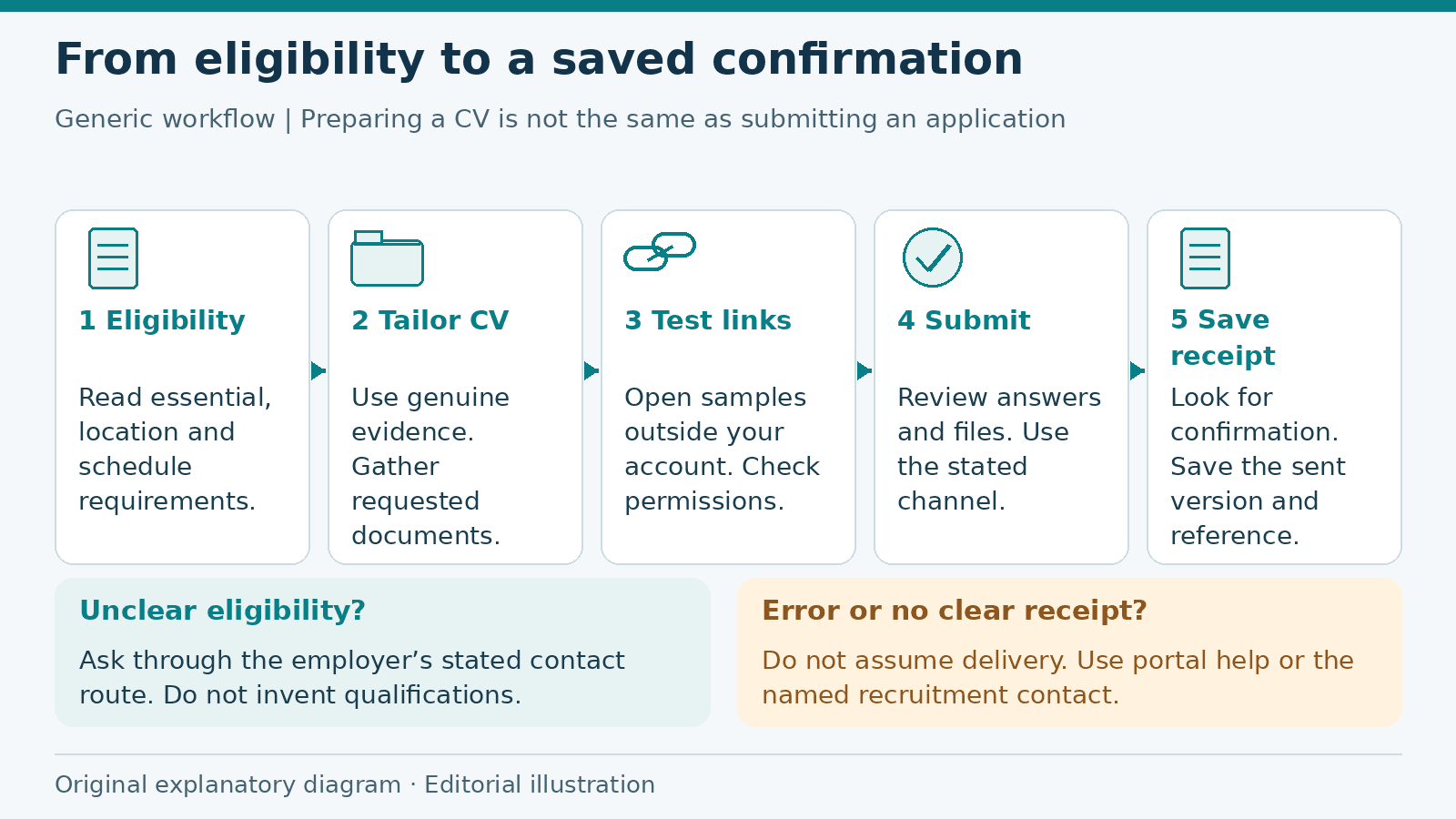
Job Application Checklist: From Eligibility to Submission
Prepare a job application from eligibility checks to submission confirmation, with a fictional worked example, document guidance and a practical checklist.
Read more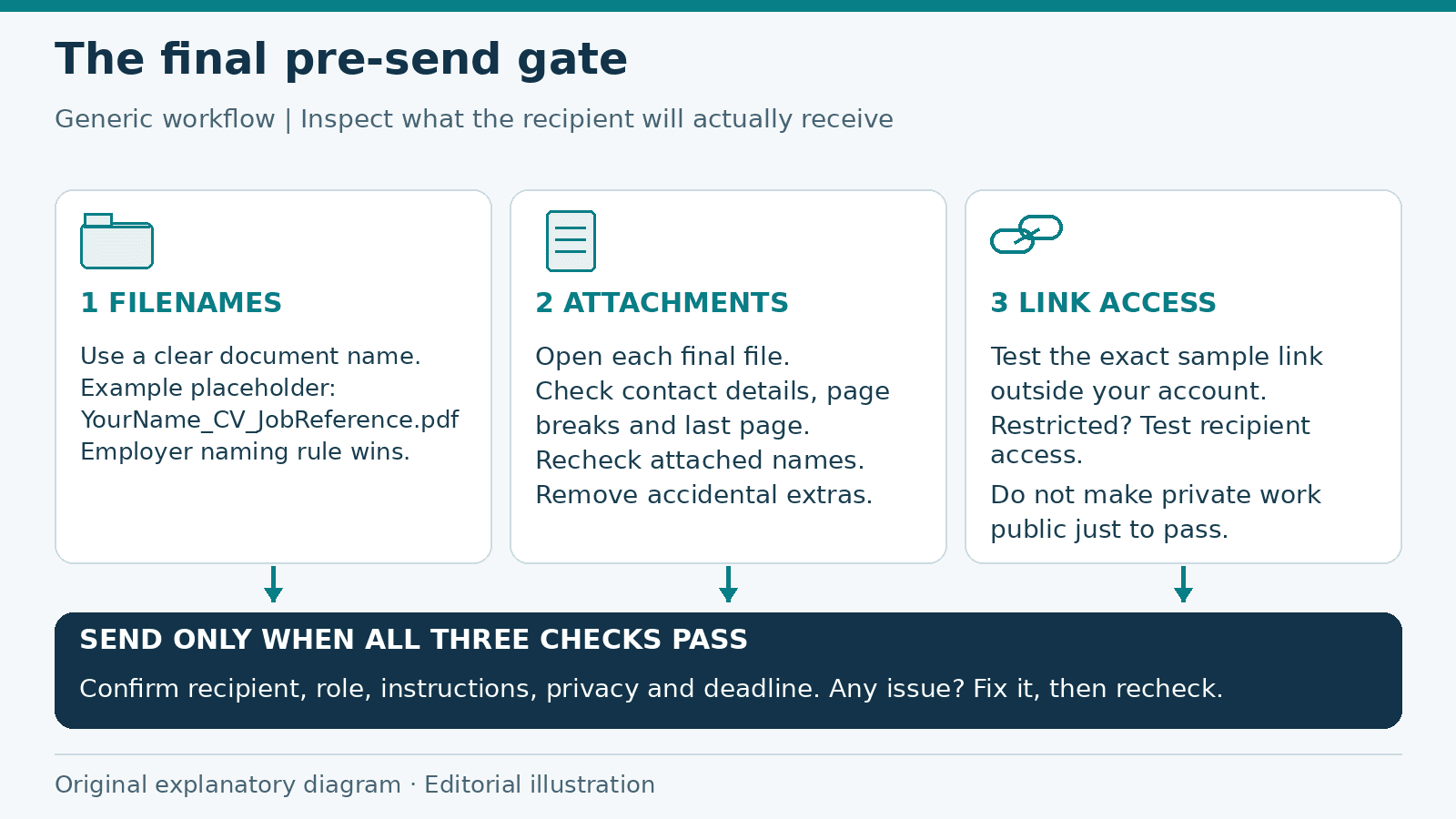
Job Application Checklist: Final Checks Before You Send
A final pre-send review of application filenames, attachments, link permissions and private information, with a checklist to catch preventable mistakes.
Read more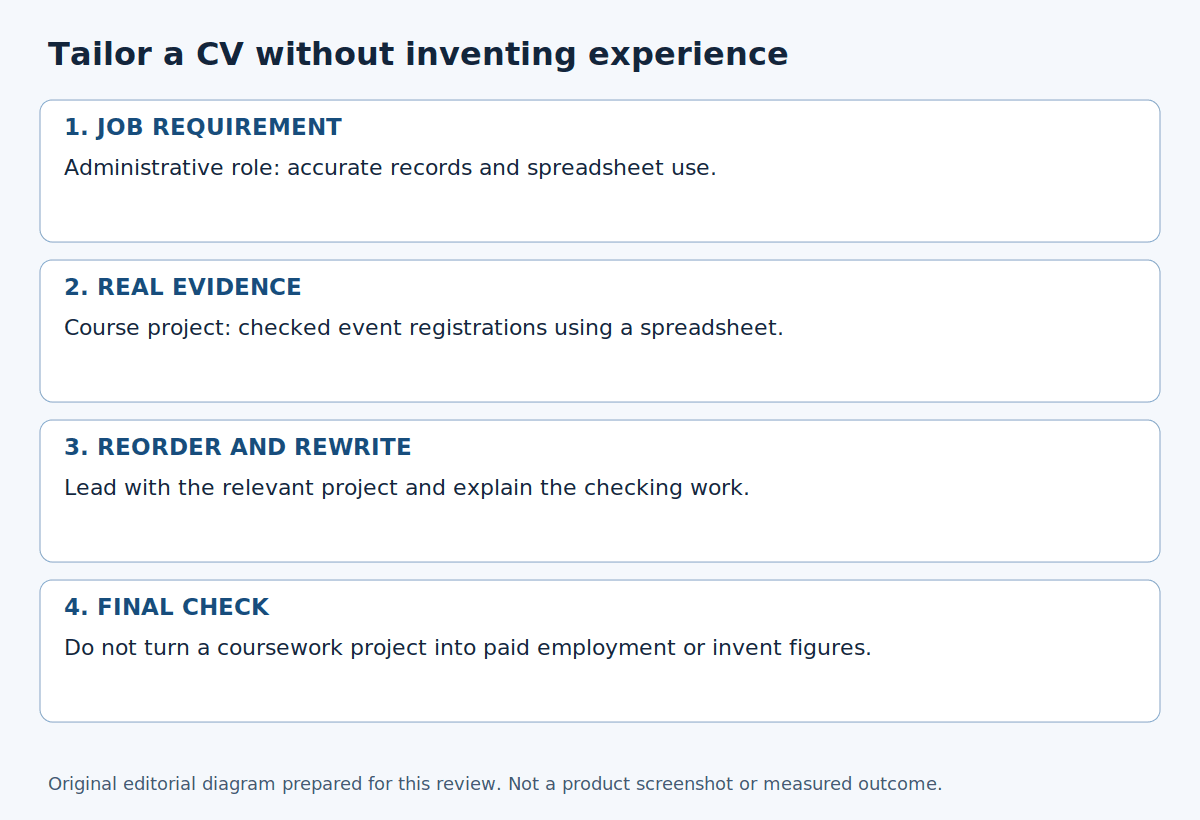
How to Tailor Your CV to a Job Description
Match a job advert to genuine experience, choose the right examples and reorder your CV without inventing skills, qualifications or results.
Read more
Comments (0)
Sign in to join the discussion.
No comments yet. Start the conversation.