
Article
Estonia e-Residency vs TRP: A Founder's 2026 Business and Investor Guide
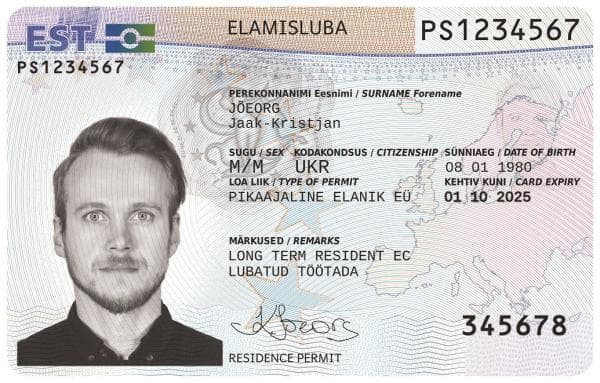
Imagine Arif, a founder in Dhaka, opening his laptop late at night. He has customers in Europe and wants an EU company that he can manage without moving immediately. A blue Estonian digital ID card appears in his research. The word “Residency” catches his eye. He begins to wonder: if he becomes an e-resident, can he move to Tallinn, operate his company there, and receive a temporary residence permit?
That single word creates one of the most expensive misunderstandings in Estonia business migration. Arif is actually looking at two separate doors. The first opens Estonia's digital business environment. The second opens a legal route to live in Estonia. They may be used in the same business journey, but one does not automatically unlock the other.
Estonia e-Residency vs TRP in one sentence: e-Residency is a digital identity for online services and remote company management; an Estonian temporary residence permit is immigration permission to settle and live in Estonia under a qualifying legal basis.
This 2026 guide follows the founder's journey from digital identity to company formation and, where the facts support it, a business or investor residence application. It explains when e-Residency is useful, when it is not required, what the EUR 65,000 and EUR 1 million figures really mean, and why simply owning an Estonian company never guarantees residence.
The first door: what Estonia e-Residency actually gives you
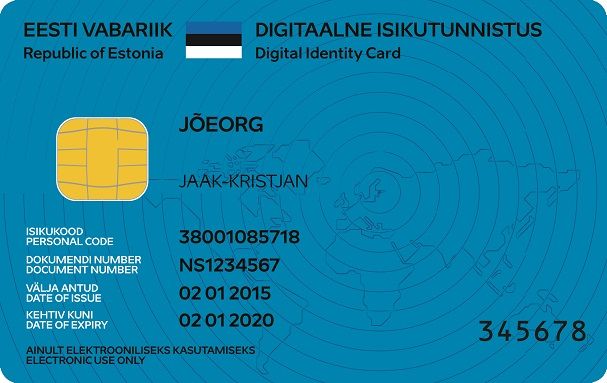
Sample Estonian e-Residency digital ID card. It is not a valid travel document, visa, or proof of physical residence.
Arif's first goal is practical: sign documents, enter the Estonian e-Business Register, manage an OÜ private limited company, and handle government services from Bangladesh. This is where e-Residency can be powerful. Estonia describes it as a government-issued digital identity and status for non-residents. The chip enables secure authentication and legally recognized digital signatures.
What the card does not do matters just as much. It does not give Arif citizenship, personal tax residency, a visa, physical residency, or the right to enter Estonia or the European Union. It is not valid physical identification and cannot replace his passport. Approval for e-Residency also does not guarantee that a bank or payment provider will open an account.
In other words, e-Residency lets Arif operate digitally from where he already lives. It does not give him permission to relocate. Estonia's official explanation of e-Residency makes this separation explicit.
The second door: what an Estonian temporary residence permit gives you
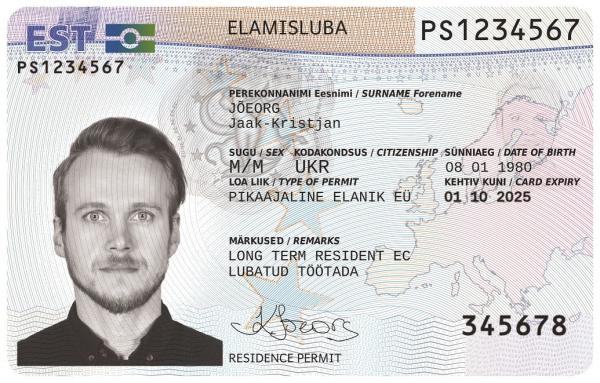
Sample Estonian temporary residence permit card shown for comparison only. It is not a valid residence or travel document.
Several months later, suppose Arif decides that remote management is no longer enough. His company needs an office, local operations, and his full-time presence in Estonia. He is no longer asking a digital-services question. He is asking an immigration question.
Under Estonia's Aliens Act, a temporary residence permit allows a foreign national to settle and live in Estonia in accordance with the law and the conditions stated on the permit. Possible legal bases include family, study, employment, enterprise, treaty grounds, and certain other categories. A permit may be issued for up to five years, but the actual period and conditions are decided for the individual case.
General conditions can include a justified purpose, an actual residence in Estonia, sufficient legal income, and medical insurance. Each route adds its own requirements and exceptions. A TRP normally provides the right to live and, in many cases, work in Estonia subject to its conditions. The residence card proves immigration status, but international travel still requires the appropriate valid passport or travel document.
Estonia e-Residency vs temporary residence permit: quick comparison
| Question | e-Residency | Temporary residence permit |
|---|---|---|
| Primary purpose | Digital identity and access to Estonian e-services | Legal permission to settle and live in Estonia |
| Can you live in Estonia? | No | Yes, while valid and conditions are met |
| Can you enter Estonia without a visa? | No; normal entry rules still apply | Residence and re-entry rights apply with a valid travel document and applicable rules |
| Can you register a company online? | Yes, when all required participants have an accepted Estonian digital identity | A resident digital ID can support online administration, but company registration is separate |
| Does it create a right to work? | No | Often, depending on the permit basis and conditions |
| Is it a travel document? | No | No; it accompanies, rather than replaces, the passport |
| Does it automatically create personal tax residency? | No | No single card decides tax residence; physical presence and tax rules matter |
| Does company ownership guarantee it? | No; the e-Residency application is assessed separately | No; the immigration application is assessed separately |
Is e-Residency mandatory before applying for a business TRP?
No. E-Residency is not a statutory requirement for an Estonian temporary residence permit for enterprise or for the large-investor route. The current Aliens Act sets out the business, investment, purpose, income, insurance, and other immigration conditions. It does not say that the applicant must first become an e-resident.
Why, then, do so many business-migration journeys begin with e-Residency? Because it is often the easiest operational bridge. If all founders, board members, and other required participants have an accepted Estonian digital identity, they can register the company online. They can then sign resolutions and manage many filings without flying to Estonia.
But “convenient” is not the same as “mandatory.” Estonia's official online company-registration guide explains that founders who lack the required digital identities can use an Estonian public notary. E-Residency is therefore one route to setting up and managing the company, not a hidden legal condition for immigration approval.
For Arif, obtaining e-Residency first may still make sense. It gives him a clean digital workflow while he tests the business. Hasanat's Estonia e-Residency and company formation guidance is designed for this online-first stage. If Arif's real objective is relocation, however, he must separately map a residence route through the Estonia residence and settlement planning service.
Is there an Estonia investor visa or golden visa?
People frequently search for an “Estonia investor visa,” but that phrase can hide important legal differences. Estonia does not offer a simple passive golden visa where purchasing an apartment or transferring money automatically creates residence. The Aliens Act instead provides purpose-based temporary residence permits for enterprise, including a special category for a large investor.
The correct route depends on what the applicant will actually do: own and operate a company, work as a director or specialist, build a qualifying startup, operate as a sole proprietor, or make and maintain a large investment. Calling every option an investor visa can lead to the wrong documents, the wrong capital plan, and unrealistic promises.
Route 1: company shareholder and the EUR 65,000 enterprise TRP
Return to Arif's story. His consulting company is registered, but registration alone is not enough. For the ordinary shareholder enterprise route, the applicant must have a holding in an Estonian Commercial Register company, sufficient money for business activity, and a reason why the applicant's settlement in Estonia would significantly contribute to the purpose of the enterprise permit.
The current law normally requires a shareholder to have invested at least EUR 65,000 in the share capital of the Estonian company. The provision connects that capital to real estate, machinery, or equipment acquired in Estonia and recorded as fixed assets. This is more specific than depositing EUR 65,000 temporarily or showing a bank balance on application day.
The applicant must normally submit a business plan in Estonian or English. A credible plan connects the capital to actual operations: what the company sells, who its customers and suppliers are, why the founder needs to be in Estonia, what assets and staff are required, and how the activity will contribute to the Estonian economy. The Police and Border Guard Board assesses the entire case; the investment threshold is not a purchase price for guaranteed approval.
After one year, the law provides alternative ongoing business-performance measures in certain circumstances, including annual sales revenue of at least EUR 200,000 or an Estonian social-tax contribution benchmark connected to five times the annual average gross wage. These are compliance measures, not marketing shortcuts, and should be checked against the current wording when planning an extension.
Route 2: sole proprietor and the EUR 16,000 requirement
Now imagine that Arif is not building a limited company. He wants to operate personally as a sole proprietor entered in Estonia's Commercial Register. The normal capital requirement for this route is at least EUR 16,000 invested in Estonia.
The lower number does not make the application automatic or suitable for every freelancer. The applicant must still demonstrate a genuine business, adequate resources, a justified reason to settle, and compliance with the general immigration conditions. The commercial form must match the reality of the activity.
Route 3: Estonia Startup Visa and startup residence permit
Suppose Arif changes direction and builds a technology platform with an innovative, scalable model intended for global growth. He may now be looking at Estonia's startup pathway. But adding the word “technology” to a traditional agency does not turn it into a qualifying startup.
The Startup Committee normally evaluates whether the business meets Estonia's startup definition. A qualifying startup can benefit from exceptions to the ordinary enterprise route, including relief from the standard paid-in capital requirement and the ordinary business-plan requirement. This pathway is designed for genuinely innovative and scalable businesses, not restaurants, ordinary trading companies, or one-person consultancies.
The Startup Visa and startup residence permit are not identical. A long-stay visa supports temporary entry and stay. A temporary residence permit supports longer residence. Startup Estonia's foreign-founder guidance tells an approved founder to determine whether a visa is required and, after company registration, apply for the appropriate business residence permit.
Route 4: a young company backed by qualifying investment
There is another carefully limited exception. The ordinary EUR 65,000 investment requirement may not apply when a company has been registered for less than 12 months and starts operating with qualifying state or private backing. The law refers to investment or a loan from the state or from a private fund manager licensed by the Financial Supervision Authority, or support from a public measure.
This is not a general exemption for money borrowed from a friend or transferred by the founder. The source, legal form, licensing, documents, and timing of the backing matter. An applicant relying on this route should preserve every agreement, bank trail, investment decision, cap-table change, and proof of how funds enter the business.
Route 5: the EUR 1,000,000 large-investor residence permit
Now imagine a different applicant, Elena, who is relocating a substantial operating business or deploying institutional-scale capital into Estonia. The large-investor route is built for this situation. Under the Aliens Act, a large investor is a foreign national who has made a direct investment of at least EUR 1,000,000 into a company registered in the Estonian Commercial Register that invests primarily in the Estonian economy, or into a qualifying investment fund whose policy primarily invests in Estonian-registered companies.
The investment must remain in place throughout the permit's validity, apart from allowed market-price movement or a qualifying change of investment. This route has a limited exception from the usual actual-dwelling and registered-place-of-residence requirements. It remains a regulated residence permit, not an automatic reward for transferring funds. The authority can examine whether the investment is genuine, lasting, in the public interest, and significantly contributes to Estonia's economic development.
Route 6: founder, director, or specialist through employment
Not every business owner belongs on an enterprise permit. A founder who will perform real management duties, or a specialist employed by the company, may need to examine an employment-based route. These categories have separate rules involving the company's registration and actual activity, the applicant's function, salary, economic contribution, and sometimes labour-market approval or exemptions.
The right answer begins with the real relationship between the person and the company. Is the applicant primarily investing capital, operating as an entrepreneur, directing a functioning company, or being hired for professional work? Choosing the legal basis after examining the facts is safer than shaping the facts around a preferred label.
A practical journey from e-Residency to a business TRP
- Define the real goal. Decide whether you only need an Estonian digital company, need short business visits, or genuinely intend to settle and operate in Estonia.
- Choose the company-formation method. Use e-Residency for a fully digital workflow when eligible, or use the Estonian notary route where digital identities are unavailable.
- Build genuine operations. Establish customers, contracts, accounting, capital records, assets, management decisions, and a defensible reason for an Estonian presence.
- Select the correct immigration basis. Compare shareholder enterprise, sole proprietor, qualifying startup, large investor, and employment routes.
- Document every euro. Preserve banking evidence, source-of-funds records, share-capital contributions, fixed-asset purchases, investment agreements, and payroll or revenue evidence.
- Prepare the route-specific case. This may include a business plan, proof of legal income, medical insurance, accommodation, identity documents, biometrics, and evidence of the applicant's role.
- Verify current procedure before filing. State fees, filing locations, immigration-quota treatment, required forms, and authority guidance can change.
- Wait for the official decision. Do not treat company registration, e-Residency approval, a startup evaluation, or an investment transfer as a residence-permit guarantee.
Four stories, four different answers
The remote agency owner
Arif continues living in Bangladesh and serves European customers online. He needs digital signatures and an EU company, not immigration permission. E-Residency and company formation may solve his present problem. Applying for a TRP before the company has a genuine reason for his presence would solve a problem he does not yet have.
The traditional business relocating operations
A manufacturer plans to acquire equipment, employ staff, and manage an Estonian operation. The shareholder enterprise route may deserve analysis because capital, fixed assets, actual activity, and the founder's presence are connected. The business plan and evidence—not the e-Residency card—carry the immigration case.
The technology startup founder
A founder has a scalable technology product and international growth plan but cannot meet the ordinary EUR 65,000 structure. Startup Committee assessment may open the startup pathway and its specific exceptions. The founder still needs the correct visa or residence application after the startup decision.
The large investor
An investor commits at least EUR 1 million to a qualifying Estonian company or fund and maintains the investment. This may fit the large-investor category. Buying property for personal use or parking funds without the required economic purpose is not the same thing.
Banking, tax, and family questions that come next
E-Residency does not guarantee banking. Banks and payment providers conduct their own identity, business-model, anti-money-laundering, and risk reviews. A clear connection to Estonia can matter, and applicants should not build a company plan around an assumed account approval.
E-Residency also does not change the founder's personal tax residence. An Estonian company has Estonian obligations, while cross-border management, permanent establishment, salary, dividends, and the founder's country of residence can create obligations elsewhere. A TRP card alone does not settle every tax question either; physical presence and domestic tax rules matter.
A founder's permit does not silently grant residence to family members. Spouses, partners, and children need the appropriate family-based applications and supporting documents. Plan the family's immigration, insurance, schooling, housing, and budget alongside the business route rather than after the founder applies.
Frequently asked questions about Estonia e-Residency and investor residence
Can I get an Estonian TRP only because I have e-Residency?
No. E-Residency provides a digital identity, not an immigration status. You must qualify separately under a residence-permit basis such as enterprise, employment, study, or family.
Do I need e-Residency to register an Estonian company?
You need an accepted Estonian digital identity for the fully online registration route, and all required participants must be able to sign digitally. Without that, company formation can proceed through an Estonian public notary. Therefore, e-Residency is useful but not universally mandatory.
Does investing EUR 65,000 guarantee an Estonia residence permit?
No. The threshold is part of the ordinary shareholder enterprise rules, not a guaranteed-approval fee. The legal structure, use of capital, business plan, economic contribution, applicant's role, general immigration conditions, and credibility of the evidence are also assessed.
Can I obtain Estonian residence by buying property?
Property ownership alone is not a simple golden-visa route. Real estate can be relevant as a company fixed asset in the statutory enterprise framework, but buying a personal home does not automatically produce a TRP.
What is the minimum investment for Estonia's large-investor route?
The current statutory minimum is EUR 1,000,000 in a qualifying Estonian company or qualifying investment fund. The investment must primarily support the Estonian economy and remain in place during the permit.
Is every new technology company eligible for the Startup Visa?
No. The business normally needs Startup Committee approval and must satisfy Estonia's definition of an innovative, technology-based, scalable venture with global growth potential.
Can an e-resident travel visa-free to Estonia?
No. E-Residency does not change nationality-based visa or border rules. The applicant must qualify for visa-free entry, obtain a visa, or hold another valid immigration status.
How long can an Estonian temporary residence permit be valid?
The Aliens Act allows a temporary residence permit to be issued for up to five years. The actual duration depends on the legal basis, facts, supporting evidence, and decision in the individual case.
Does e-Residency make me an Estonian tax resident?
No. Estonia's official programme states that e-Residency does not confer personal tax residency. Obtain cross-border tax advice for both the company and its owners.
What should you do next?
If your goal resembles Arif's first chapter—forming and managing an Estonian company online—review Hasanat's Estonia e-Residency and company formation service. It focuses on digital-ID preparation, company setup, and the sequence for remote founders.
If your real destination is Estonia itself, start with Hasanat's Estonia temporary residence and settlement-planning service. The purpose is to compare the available routes, identify evidence gaps, and build a realistic timeline before you make a major investment or relocation commitment.
Official sources and further reading
- Estonia e-Residency: what e-Residency is and is not
- Official guide to the Estonian e-resident digital ID card
- Official online company-registration steps and notary alternative
- Official guidance for e-residents who want to live and work in Estonia
- Startup Estonia guidance for foreign founders
- Current Estonian Aliens Act in English
Editorial note: This guide distinguishes verified legal rules from practical recommendations and uses fictional founder scenarios to explain the decision process. It provides general educational information, not individualized legal, immigration, investment, or tax advice. Requirements, fees, restrictions, and procedures can change. Verify your facts with Estonia's Police and Border Guard Board, the official e-Residency programme, and qualified legal and tax professionals before applying or transferring funds. Substantively reviewed on 14 September 2026.
Read next
View all articlesEstonia Business Visa Process: EUR 65,000 TRP Route (2026)
Estonia business visa process: lawyer file assessment, EUR 65,000 company route, e-Residency, TRP documents, official fees and arrival planning.
Read more
Binance Hack 2026: What Happened and Why It Matters
The Binance hack in October 2026: what Binance has confirmed, how signing systems can be abused, and practical security lessons for developers and users.
Read more
Custom ERP Project Checklist for Small Businesses
Plan a successful custom ERP implementation with this small business checklist covering requirements, budgeting, software development, data migration, security, testing, and deployment.
Read moreExplore related career opportunities
Find roles that fit your location and interests. Each listing explains its current or planned vacancies.
All locations, roles and employment types
Comments (0)
Sign in to join the discussion.
No comments yet. Start the conversation.