
Article
Estonia Business Visa Process: EUR 65,000 TRP Route (2026)
Moving from a business idea to a lawful business presence in Estonia is not one application. It is a sequence of decisions, documents, business preparation and immigration steps. Each stage must support the next: the person, the company, the funding, the business plan and the travel purpose should all tell one truthful, consistent story.
Estonia business visa process: first identify whether you need a short business visit, a long-stay D visa, or a temporary residence permit for enterprise. Then prepare the company and evidence required for that specific route.
This 2026 guide follows the full 13-step pathway commonly used by founders and investors: initial document review, profile assessment, e-Residency where useful, business development, Estonian company formation, residence-permit preparation, arrival and long-term planning. It also separates government fees from company costs and investment conditions.
This is not a rigid checklist. Some work happens in parallel: the lawyer reviews the file while the founder documents source of funds; the business plan develops alongside company preparation; and the application route is confirmed before any non-refundable travel is booked. The steps below are a control framework, not a promise that every applicant should follow every stage in the same order.
Step 1: File assessment with a qualified lawyer
Start with a file assessment by an Estonian-qualified immigration or business lawyer before forming a company or transferring capital. The assessment should test the proposed legal route, the founder's role, source of funds, business model, investment plan, document gaps, immigration history and the practical need to live in Estonia. A lawyer cannot guarantee approval; the authority alone makes the decision. The purpose of the assessment is to identify risks early and avoid building the wrong case.
Prepare a working file for that assessment: valid passport, recent photographs, current address evidence, education and professional background where relevant, tax and income records, existing business documents, bank statements and a clear source-of-funds narrative. For documents issued outside Estonia, confirm whether apostille or legalisation and translation into Estonian or English are required. A lawyer's assessment fee is a private professional fee, not an Estonian government fee, so obtain a written scope and quote first.
Step 2: Profile assessment and route selection
At this stage, define the real purpose. A person travelling for meetings, trade events or negotiations usually researches a short-stay Schengen C visa. A person needing a temporary longer stay may need a D visa. A founder who genuinely intends to settle in Estonia and operate a qualifying enterprise researches a temporary residence permit (TRP) for enterprise, startup, large investor, or sometimes employment.
For the company-based route, this guide focuses on the ordinary EUR 65,000 shareholder enterprise route. It is the more structured path for a founder building an Estonian OÜ with genuine investment in business assets and a documented operating plan. A business visitor does not automatically become a resident, an e-resident does not automatically receive a visa, and a company owner does not automatically receive a TRP.
Step 3: e-Residency application where it supports the plan
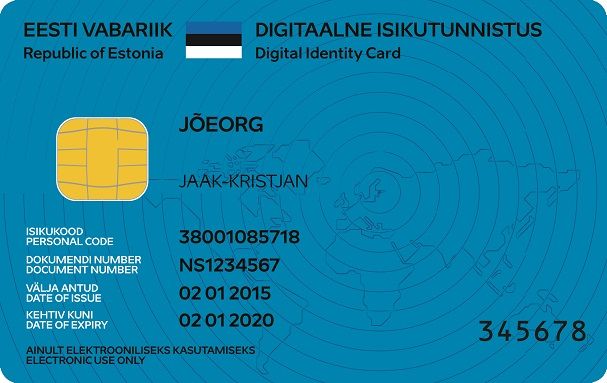
Sample e-Residency digital ID card. It is not a visa, travel document, or residence permit.
e-Residency can support a remote-first company plan. It gives an approved non-resident a secure Estonian digital identity for authentication, digital signatures and access to online services. It can be useful for registering and managing an Estonian company online when the necessary company participants have accepted Estonian digital identities.
It is optional from an immigration perspective. e-Residency is not a legal requirement for a business TRP and does not give a right to enter, live or work in Estonia. The current state fee is EUR 150, paid during the official application. Treat it as a digital-business tool, not as an immigration approval.
Step 4: e-Residency card collection and digital access
After an e-Residency application is approved, collect the kit from the pickup location selected in the official process and follow the security instructions for the PIN codes and card reader. Keep the card and codes secure. The card allows digital access; it does not replace a passport, visa or residence card.
Use this stage to confirm that the company can be formed online. If the required founders or board members do not have an accepted Estonian digital identity, company formation can use an Estonian public notary route instead.
Step 5: business preparation and a credible operating plan
Build the business before building an immigration claim around it. Define the product or service, customer segment, pricing, suppliers, team, expected revenue, funding, fixed assets and Estonia-specific activity. A realistic plan explains why the company needs an Estonian presence and why the founder's personal presence in Estonia is necessary.
For the ordinary enterprise TRP, the business plan is an important part of the evidence and normally must be in Estonian or English. It should match the company documents, capital records, invoices, contracts and financial forecast. Avoid generic text that could describe any business in any country.
Step 6: home-country business background and compliance
Where relevant, a lawful and documented business history in the founder's home country can help explain experience, source of funds, clients and commercial track record. This may include tax returns, trade licence records, company incorporation documents, audited accounts, invoices or client contracts.
However, a Bangladeshi company, sole proprietorship or trade licence is not a universal Estonia visa requirement. Use home-country documents only where they truthfully support the case. The Estonian authority assesses the legal basis and evidence for the Estonian application, not a fixed checklist invented for every applicant.
Step 7: business development and evidence of real activity
Before applying on a business basis, organise the evidence that shows the company is more than a name on a register. Depending on the stage and route, this can include customer research, signed contracts, invoices, product development, supplier arrangements, asset purchases, capital contributions, accounting records, payroll plans and management decisions.
Every claim should be verifiable. Do not create artificial turnover, recycled capital, false contracts or paper-only activity. A strong application is built on genuine commercial facts, not on a polished document folder.
Step 8: Estonia business formation
Once the ownership, business model and administration plan are clear, form the Estonian company in the appropriate way. An OÜ is Estonia's common private limited company. The official online-registration state fee is EUR 265. Where required, budget for a contact person and legal address; the official e-Residency programme gives a typical contact-person range of about EUR 200-400 per year.
Company formation is not the same as residence approval. A company can be registered and operated remotely without its owner becoming an Estonian resident. Banking and payment providers also make their own compliance decisions, so never assume an account is guaranteed.
Step 9: capital, assets and the EUR 65,000 enterprise-route preparation
This is the core investment stage for the ordinary shareholder enterprise route. The current Aliens Act normally requires at least EUR 65,000 invested in the share capital of an Estonian company and used for real estate, machinery or equipment recorded as fixed assets in Estonia. This is why the plan, budget, asset schedule, invoices, accounting treatment and source-of-funds evidence must be ready before the TRP application.
The EUR 65,000 is not a state fee, an agent charge or money that can be temporarily displayed and withdrawn. It is a legal investment condition tied to genuine business activity. Preserve the full trail: source of wealth, bank transfers, share-capital documentation, asset purchase invoices, ownership, fixed-asset register and evidence that the business is operating in the way described in the application.
Why this guide does not treat sole proprietorship as the preferred path
The Aliens Act provides a separate sole-proprietor route with a normal EUR 16,000 investment condition. It can be lawful for the right fact pattern, but it is usually not the preferred structure for a founder planning to build a separate Estonian company, hold substantial business assets, add partners or employees, or create a clearer company-level investment record.
A sole proprietor and an OÜ have different legal, liability, tax, administration and immigration implications. The lower EUR 16,000 figure should not be treated as an easier substitute for the EUR 65,000 shareholder route. The lawyer-led file assessment should decide whether it genuinely fits; this guide concentrates on the EUR 65,000 OÜ shareholder route because that is the more robust company-based pathway for the business model described here.
A qualifying startup may have exceptions from the ordinary capital and business-plan requirements after the appropriate startup assessment. The large-investor route has a statutory threshold of at least EUR 1,000,000 in a qualifying Estonian company or qualifying investment fund, and the investment must remain in place during the permit.
Step 10: temporary residence permit preparation and submission
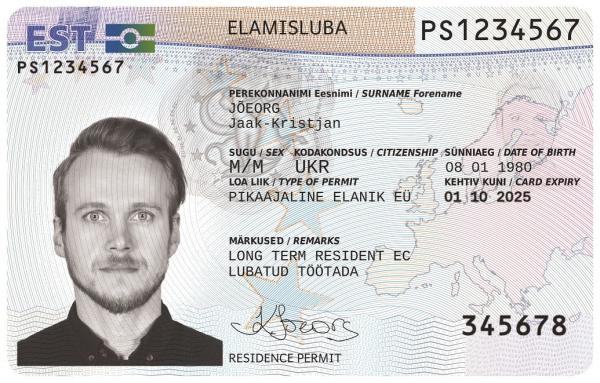
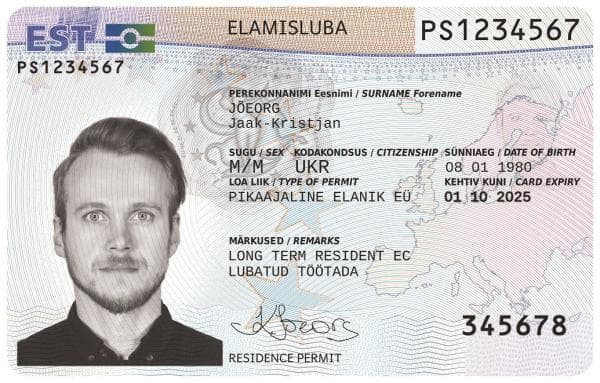
Sample temporary residence permit card for educational comparison only. It is not a form and does not prove eligibility.
When the business case is ready, obtain the current form and checklist from the Estonian Police and Border Guard Board or the Estonian foreign mission handling the application. Complete every field with passport-exact information. The application, business plan, company register, bank records, capital evidence, insurance, income evidence and accommodation information must be consistent.
The current statutory fee for a business TRP is EUR 350 when filed in Estonia and EUR 380 at a foreign mission. The State Fees Act also lists a EUR 20 document-issue charge at a foreign mission for the relevant documents. Pay only using the official instructions valid at the time of filing.
Step 11: authority review, visa decision and travel planning
The competent Estonian authority reviews the evidence and makes the decision. Approval is never guaranteed by e-Residency, company registration, a business plan, an investment transfer or payment of a state fee. Respond accurately if additional documents are requested, and keep your business facts current during processing.
If a long-stay D visa is the correct temporary route, its adult state fee is currently EUR 120. If the plan is only a short business visit, the current adult Schengen C visa state fee is EUR 90. Travel insurance, translation, apostille, flights and accommodation are separate real-world costs. Do not buy non-refundable travel before the correct authority and route have been confirmed.
Step 12: arrival, address registration and local setup
After receiving the appropriate legal right to stay, arrive in Estonia with the required passport, visa or residence documentation. Register a local address when required, collect the physical residence card through the instructed process, arrange health coverage, set up local administration and keep company records in order.
Arrival is not the end of compliance. The permit conditions, registered details, business activity, insurance, income and tax obligations must remain accurate. Notify the relevant authority when facts change.
Step 13: long-term residence planning
Long-term residence is a separate future goal, not an automatic reward for opening a company or staying for a few years. Plan renewals, lawful income, continuous compliance, language requirements where applicable, tax residence, family arrangements and actual presence in Estonia from the beginning.
A business that exists only on paper can create problems at renewal. The sustainable approach is to run the company properly, keep evidence of operations, follow tax and corporate obligations, and reassess eligibility under the rules in force when the next application is due.
Complete cost and fee map for the Estonia business process
No article can give one final price for every case because professional services, translations, insurance, travel, accommodation, banking and company operations vary. The table below separates every predictable category so that a reader can request itemised quotes and avoid confusing fees with capital.
| Cost category | Current fee or range | What it covers |
|---|---|---|
| Lawyer file assessment | Private quote required | Professional review of route, risks, evidence and scope; not a government fee |
| Document translation, apostille or legalisation | Private quote required | Depends on country, language, document type and authority instructions |
| e-Residency application | EUR 150 | Optional digital identity; not a visa or TRP |
| OÜ online registration | EUR 265 | Company-registration state fee |
| Contact person and legal address | About EUR 200-400 per year for a contact person | Company-administration cost when required; confirm legal-address pricing separately |
| Accounting | From about EUR 50 per month | Operating cost; depends on transactions, payroll, VAT and scope |
| Business banking or payment account | Provider quote required | Private provider charge and compliance decision; account approval is not guaranteed |
| Schengen C business visa | EUR 90 | Short-stay visa state fee; external application-centre service fee may be additional |
| Long-stay D visa | EUR 120 | Temporary long-stay visa state fee; proof of funds is separate from the fee |
| Business TRP filed in Estonia | EUR 350 | Residence-permit application state fee |
| Business TRP filed at foreign mission | EUR 380, plus EUR 20 document-issue charge where applicable | Residence-permit state fees; verify current payment instructions before filing |
| Health insurance | Insurer quote required | Coverage must meet the requirements for the chosen route |
| Flights, accommodation and local arrival costs | Travel-provider quote required | Private travel and relocation expenses; avoid non-refundable bookings before the decision |
| EUR 65,000 shareholder investment | EUR 65,000 | Core company capital and fixed-asset condition, not an application fee |
| Sole proprietor route | EUR 16,000 investment condition | Alternative route only; not the preferred OÜ shareholder route in this guide |
| Large-investor route | EUR 1,000,000 | Investment condition, not an application fee |
For Bangladeshi taka, use the EUR selling rate shown by your bank or card provider on the payment day and add card, transfer, centre, translation and travel charges. Exchange rates change, so a fixed BDT quote should never be treated as the final cost.
Estonia business visa requirements and cost: common questions
What are the Estonia business visa requirements?
The requirements depend on the purpose of travel. A short business visit normally needs a Schengen C visa application with a truthful travel purpose and supporting evidence. A D visa is for temporary longer stay. A business residence permit needs evidence of a qualifying enterprise basis, business activity, investment or startup status where applicable, as well as the general immigration conditions. There is no single checklist that fits every founder.
How much does an Estonia business visa cost?
The official adult Schengen C visa state fee is EUR 90 and the official D visa state fee is EUR 120. A business temporary residence permit costs EUR 350 when filed in Estonia or EUR 380 at a foreign mission. e-Residency costs EUR 150 and an online OÜ registration costs EUR 265. Translation, apostille, insurance, travel, external-centre fees, company administration and business capital are separate costs.
Can a Bangladeshi citizen apply for an Estonia business visa?
Yes, a Bangladeshi national can apply through the route that matches the purpose and can document eligibility. For a short-stay visa, Estonia directs applicants to the Estonian representation or the Schengen state representing Estonia in the country of residence. For a long-stay visa or residence permit, confirm the current Estonian mission and appointment process before travelling to submit an application.
Do I need e-Residency for an Estonia business visa or residence permit?
No. e-Residency is a digital identity for online services and company administration. It is useful for some company-formation plans, but it is not a visa, residence permit, travel document or mandatory business-TRP requirement.
Does Estonia have an investor visa?
Estonia uses purpose-based enterprise residence-permit routes rather than a simple passive golden visa. The large-investor route has a current statutory threshold of EUR 1,000,000 in a qualifying Estonian company or qualifying fund. The ordinary shareholder enterprise route has different conditions, including the EUR 65,000 investment and fixed-asset framework.
What are the Estonia Startup Visa requirements?
A startup route is for a technology-based, innovative and scalable business with global growth potential. A qualifying business normally needs Startup Committee approval before the founder proceeds with the relevant visa or residence-permit stage. An ordinary agency, trading company or small local business should not assume it qualifies as a startup.
Related Estonia resources
- Estonian TRP vs e-Residency: what is the difference?
- Estonia e-Residency and company formation guidance
- Estonia residence and settlement planning
Official sources for each stage
- Estonian Ministry of Foreign Affairs: Schengen business-visa process and EUR 90 fee
- Estonian Ministry of Foreign Affairs: long-stay D visa process, funds and EUR 120 fee
- Estonia's current country-by-country visa representation arrangements
- Estonian missions currently handling visa applications
- Official e-Residency, company-registration and administration costs
- Estonian State Fees Act
- Estonian Aliens Act: enterprise, startup and investor residence rules
This is a general educational overview of the Estonia business visa process, not legal, immigration, tax or investment advice. Verify the current form, appointment location, fee, document list and eligibility with the responsible Estonian authority before applying or paying. Last reviewed: 14 September 2026.
Read next
View all articlesEstonia e-Residency vs TRP: A Founder's 2026 Business and Investor Guide
Estonia e-Residency vs TRP explained through a founder's journey, including company formation, startup and EUR 65,000 to EUR 1 million investor routes.
Read more
Binance Hack 2026: What Happened and Why It Matters
The Binance hack in October 2026: what Binance has confirmed, how signing systems can be abused, and practical security lessons for developers and users.
Read more
Custom ERP Project Checklist for Small Businesses
Plan a successful custom ERP implementation with this small business checklist covering requirements, budgeting, software development, data migration, security, testing, and deployment.
Read moreExplore related career opportunities
Find roles that fit your location and interests. Each listing explains its current or planned vacancies.
All locations, roles and employment types
Comments (0)
Sign in to join the discussion.
No comments yet. Start the conversation.