
Article
CV with no work experience: projects and volunteering
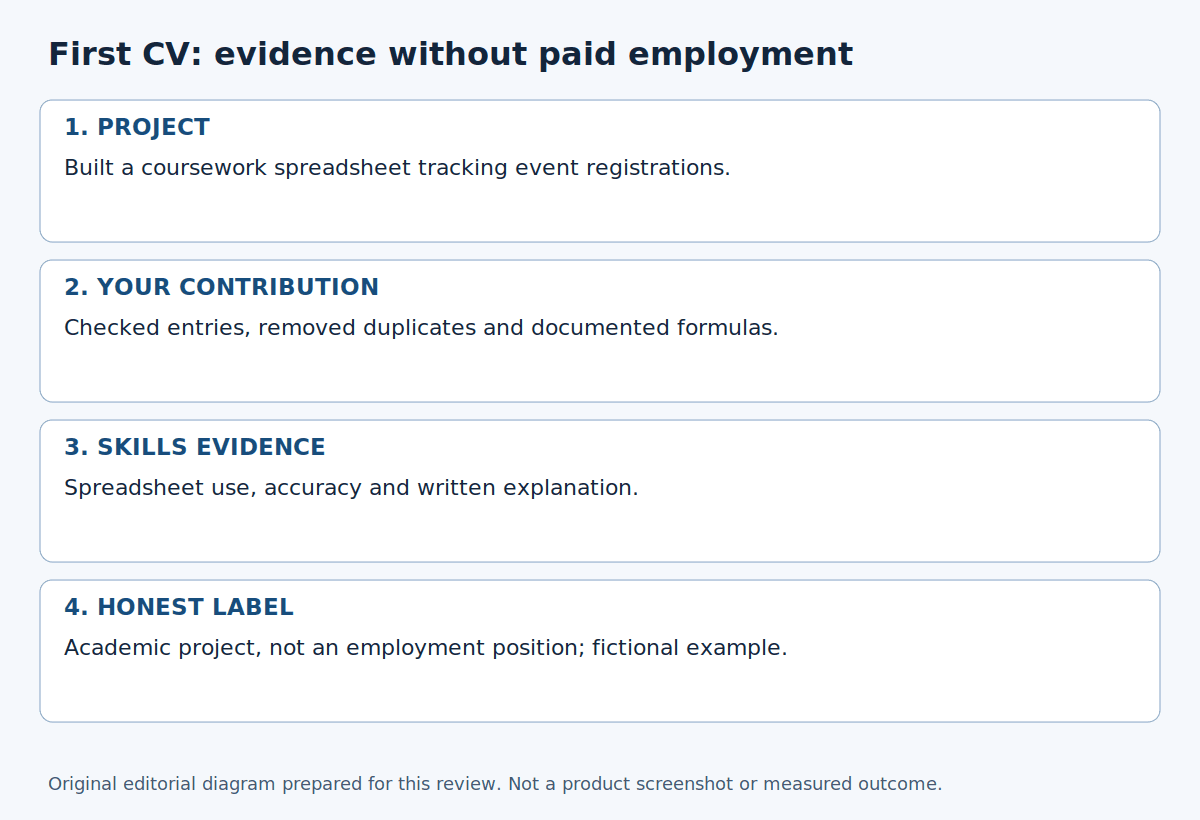
A CV with no work experience can still show useful work. A class project, a volunteer shift or a website you built for practice can demonstrate a skill. The job is to explain what you did and why it matters for the vacancy, without presenting it as paid employment.
You do not need to fill an empty work-history section with invented roles. Give relevant projects and education their own space. All sample candidates, projects and volunteer roles in this guide are fictional. Adapt a sample only when you have comparable experience.
Build the structure around your strongest evidence
Start with your name and reliable contact details. Add a short introduction if it tells the employer something useful. Then choose an order that makes your relevant work easy to find. For a student, Education followed by Projects may make more sense than putting an empty Employment section first.
A practical starting structure is:
- Contact details
- Short summary, when useful
- Education
- Academic and personal projects
- Volunteering or relevant activities
- Skills and completed training
Move sections if the evidence calls for it. A volunteer who regularly answers public enquiries may want that experience before a list of modules. You do not have to use every heading. One page is a useful editing target for a short history, but follow the employer's requirements and do not shrink the text just to force a page limit.
Write a summary with something specific in it
A paragraph about being motivated, hardworking and eager to learn could describe almost anyone. Name your field, a relevant activity and the kind of role you are seeking. If the introduction repeats the rest of the CV without adding focus, shorten it or leave it out.
A fictional administrative applicant might write: "Business administration student seeking an entry-level office role. Created a registration spreadsheet for a simulated event and wrote instructions for the project team. Comfortable organizing records and checking entries for errors."
For a marketing internship, the same person would need different evidence, such as a research assignment or writing sample. Change the emphasis to fit the vacancy, not the facts. Do not describe yourself as a graduate before completing the qualification.
Turn a project into evidence of a skill
For each project, give its name, context and date or period. Then explain the purpose, your contribution, the tools you used and what you produced. Make it clear whether it was coursework, personal practice or commissioned work.
Here is a fictional worked example for an entry-level administrative role:
Academic project: registration planning for a simulated event
- Created a spreadsheet to organize sample registrations for a class assignment.
- Checked duplicate entries and marked incomplete records for the team to review.
- Wrote a short guide explaining how teammates should update the sheet.
The example supports spreadsheet use, accuracy and written communication. It does not imply that a real event took place or that the student held an administrative job. The word "simulated" keeps the context honest.
If a team completed the project, separate your part from the whole. "Built the entire website" is inaccurate if you only wrote the contact page. Explain what you owned, who handled the other parts and what was delivered. You should be able to describe the work at interview without borrowing a teammate's achievements.
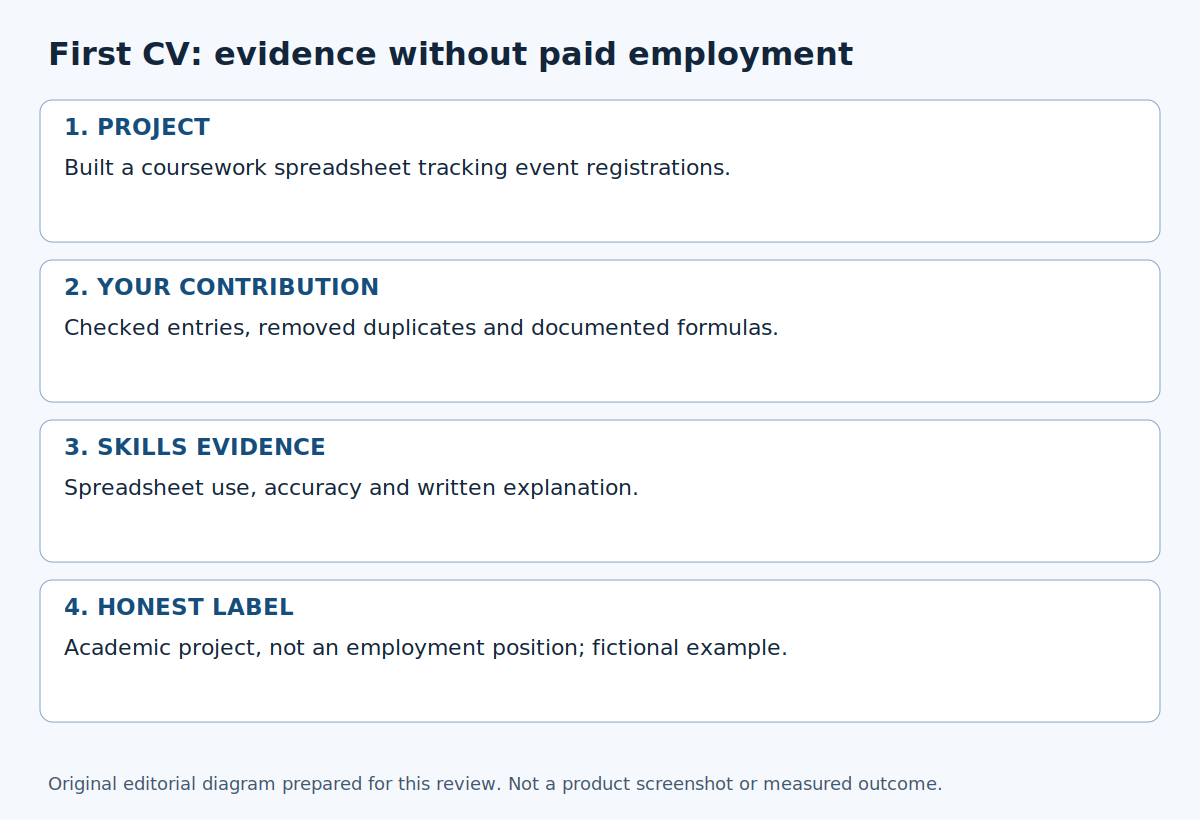
Original explanatory diagram generated for this editorial correction; not a product screenshot. The diagram contains no copied image assets. Source: this article’s worked example. No third-party image licence is asserted.
A research project can work the same way. A fictional customer buying behaviour assignment could describe preparing questions, organizing responses and presenting findings. Do not claim that the research increased a company's sales when it was a classroom exercise. Keep a shareable copy of the report only if course rules, participant privacy and any other permissions allow it.
Choose coursework that relates to the role
A long list of course names takes up space without explaining your ability. Pick the subjects that relate to the vacancy, and connect them to a real assignment where possible.
For an office role, a computer applications module might matter because you created a spreadsheet or formatted a report. For a marketing role, explain a customer research task. For a bookkeeping role, describe a practice exercise in recording transactions, while making clear it was training rather than responsibility for a real business's accounts.
Use the actual course name and qualification status. If you are still studying, give an expected completion date where appropriate. A short online course should not appear as a degree or a professional certification it did not award.
Describe volunteering without inflating the title
Include the organization or activity, your role and the dates. Explain your responsibilities in ordinary language. Tutoring, a community campaign, a student club or helping at registration can all give you evidence to discuss.
A fictional volunteer entry might read: "Volunteer, community awareness event. Explained registration steps to participants, distributed materials and referred unanswered questions to the coordinator." That is clearer than "supported a successful community initiative." It also avoids taking credit for managing the whole campaign.
Describe occasional help as occasional help. Do not turn one afternoon into a long-running role. Include an outcome or number only when you can support it. Permission to volunteer is not permission to share attendance lists, photographs or another person's contact details.
Let activities support the skills list
For each skill you want to include, ask where you used it. A project deadline can support time management. Comparing research findings can support analysis. Writing instructions can support communication. If you cannot name an example, consider whether that skill belongs on the CV yet.
Be equally precise with software. "Used spreadsheets to sort records and check duplicates" explains more than "advanced Excel" when your experience is limited. List the functions or tasks you can demonstrate; do not copy every tool mentioned in the job advert.
Personal projects are useful when they relate to the role. A practice website, a design sample or a small program can show work beyond coursework. Explain what it does, what you built yourself and whether it is a demonstration. Check any portfolio link without signing in, and remove confidential material before sharing it.
Keep the file readable and the claims accurate
National Careers Service guidance includes projects and volunteering as evidence for first-time applicants. It is UK guidance, so use the employer's instructions to decide details for an application elsewhere.
Use clear headings and short bullets. University of Pennsylvania resume guidance discusses presenting relevant experience and keeping formatting simple. Some applicant tracking systems struggle with decorative layouts; no template guarantees parsing, an interview or selection. Avoid hidden text and keyword stuffing. Use the vacancy's wording only where it accurately describes your background.
Check the requested file type, open the exported file and read it from top to bottom. Look for missing characters, awkward page breaks, unfinished placeholders and incorrect dates. Ask someone to read a project entry and tell you what they think you did. If their answer is broader than your actual contribution, rewrite it.
First-CV checklist
- Have you selected evidence that fits this vacancy?
- Are coursework, personal projects and volunteering labelled correctly?
- Do the bullets explain your individual contribution?
- Are qualifications and completion dates accurate?
- Can you demonstrate each listed tool or skill?
- Do portfolio links work, and do you have permission to share the material?
- Have you removed unsupported numbers and private records?
- Have you followed the employer's format instructions?
Prepare your next version
Start with one project you can explain well, then add the evidence that supports the role you want. You can use ALHarih Resume Builder and its CV builder guide while preparing your document. Review your own details and inspect the final file. More related guidance is available in ALHarih articles. Preparing a CV does not submit a job application or guarantee selection.
Read next
View all articles
How to Get Clients: Build a Relationship Before Asking for Work
Learn how to get clients through genuine conversations, relevant outreach, respectful follow-ups, and a professional profile that shows your work.
Read more
My First IELTS Exam Experience: I Interview Thousands of Candidates, but I Was Nervous Once, Too.
My first IELTS exam experience at GREC Banani: the nerves, the test-day surprises, and a reminder for anyone facing an interview or assessment.
Read more
Fixed-Price or Hourly Freelance Work: How to Choose
Compare fixed-price and hourly freelance work, explore the pros and cons of each pricing model, and discover how to choose the best option for your projects and income goals.
Read moreExplore related career opportunities
Find roles that fit your location and interests. Each listing explains its current or planned vacancies.
All locations, roles and employment types
Comments (0)
Sign in to join the discussion.
No comments yet. Start the conversation.