
Article
Fixed-Price or Hourly Freelance Work: How to Choose

Fixed-Price or Hourly Freelance Work: How to Choose
Freelancing gives you the freedom to choose your projects, set your rates, and work with clients from around the world. However, one of the most important decisions you need to make is how to charge for your services. Should you choose fixed-price or hourly freelance work?
Both pricing models have advantages and disadvantages. Fixed-price work offers an agreed project fee, while hourly work allows you to charge for the time you spend completing tasks. Your ideal choice depends on your skills, project requirements, experience, and financial goals.
In this article, we will explore the differences between fixed-price and hourly freelance work, discuss the benefits and drawbacks of each model, and help you determine which pricing strategy is right for your freelance business.
What Is Fixed-Price Freelance Work?
Fixed-price freelance work is a pricing model in which you and your client agree on a total project fee before the work begins. The payment is based on the agreed deliverables rather than the number of hours you spend completing the project.
For example, suppose a client hires you to design a website for $500. If you complete the project according to the agreed requirements, the project fee remains $500 whether you spend 15 hours or 25 hours working on it.
This pricing model is popular among graphic designers, web developers, content writers, SEO specialists, and other freelancers who provide clearly defined services.
Benefits of Fixed-Price Freelance Work
1. Predictable income
You know the agreed project fee before starting the work. This makes it easier to estimate your earnings, manage expenses, and plan your finances.
2. Greater rewards for efficiency
When you become more experienced and complete projects faster, your effective hourly earnings can increase without reducing the agreed project fee.
3. Clear project expectations
A fixed-price agreement can define the deliverables, deadlines, revision limits, and payment schedule. These details help prevent misunderstandings between you and your client.
4. Attractive to budget-conscious clients
Many clients prefer knowing the total cost upfront. A fixed quote allows them to plan their budgets and compare proposals more easily.
Drawbacks of Fixed-Price Freelance Work
1. Risk of underestimating the workload
If you underestimate the time, complexity, or effort required, you may earn less than expected.
2. Scope creep
Clients may request additional features or revisions beyond the original agreement. Without clear boundaries, extra work can reduce your profitability.
3. Less flexibility when requirements change
Significant changes may require a revised quote, a new deadline, or an additional agreement.
4. Possible payment delays
If payments depend on milestones or client approval, unclear terms can lead to delays. Establish payment deadlines and acceptance criteria before beginning.
What Is Hourly Freelance Work?
Hourly freelance work is a pricing model in which you charge a client for each billable hour you spend completing agreed tasks. You set an hourly rate, track your time, and invoice the client according to your agreement.
For example, if your hourly rate is $25 and you work 20 billable hours, your earnings will be $500 before platform fees, taxes, and other business expenses.
Hourly pricing is often suitable for virtual assistance, consulting, software development, website maintenance, research, and ongoing projects where the workload may change.
Benefits of Hourly Freelance Work
1. Payment based on time worked
You are compensated for approved billable hours, making this model useful when a project's workload is difficult to predict.
2. Flexibility for changing requirements
Hourly billing can accommodate evolving tasks more easily, provided the client approves the work and understands the expected costs.
3. Suitable for long-term clients
Businesses that need regular support may prefer hourly agreements because they can request work as new needs arise.
4. Easier workload tracking
Time-tracking tools help you record your working hours, monitor productivity, and estimate the effort required for future projects.
Drawbacks of Hourly Freelance Work
1. Income can fluctuate
Your earnings depend on the availability of billable work. If a client reduces your workload, your income may decrease.
2. Time tracking is necessary
You need to maintain accurate records of your hours and prepare invoices based on the agreed billing terms.
3. Clients may question your hours
Some clients may focus on the number of hours billed rather than the quality or value of your results.
4. Efficiency can reduce project revenue
If you complete a task faster, you may bill fewer hours for that task. However, the time saved can be used to serve additional clients or work on other projects.
Fixed-Price vs. Hourly Freelance Work: Key Differences
Understanding the differences between these two pricing models can help you make a better decision for your freelance career.
FeatureFixed-Price WorkHourly WorkPaymentAgreed project feeRate per billable hourBudgetKnown upfrontDepends on hours workedBest forClearly defined projectsOngoing or changing tasksTime trackingUseful for estimating profitabilityImportant for billingScope changesMay require a revised quoteCan be billed with approvalEfficiencyCan increase effective earningsMay reduce billed hours per taskMain riskUnderestimating the workloadUnpredictable billable hours
Neither pricing model is universally better. Your choice should depend on the type of service you provide, the clarity of the project requirements, and the client's expectations.
When Should You Choose Fixed-Price Freelance Work?
Fixed-price freelance work is usually a good choice when the project scope is clear and the expected deliverables can be defined before work begins.
Consider choosing a fixed price when:
The client has clearly explained the project requirements.
You can estimate the time and resources needed.
The deliverables and deadlines are measurable.
You have experience completing similar projects.
You can establish reasonable revision limits.
For example, a graphic designer creating a logo with three initial concepts and two rounds of revisions could offer a fixed-price package. The client knows what to expect, and the freelancer knows the agreed compensation.
Before accepting a project, calculate the estimated workload, include business expenses, and allow for reasonable uncertainty. Make sure additional requests are handled through a separate agreement.
When Should You Choose Hourly Freelance Work?
Hourly freelance work is often more appropriate when the project requirements are uncertain or the client needs ongoing assistance.
Consider charging hourly when:
The client frequently changes priorities.
The project involves troubleshooting or research.
You provide regular maintenance or administrative support.
The workload varies from week to week.
The total amount of work cannot be estimated accurately in advance.
For instance, a freelance developer maintaining a business website may charge hourly because the number of updates, technical issues, and support requests can vary.
Before starting, agree on your hourly r
Read next
View all articles
How to Compare Freelance Proposals Beyond the Price
Choosing a freelancer based only on price can lead to disappointing results. Learn how to compare freelance proposals by evaluating experience, project understanding, communication, deliverables, deadlines, and overall value.
Read more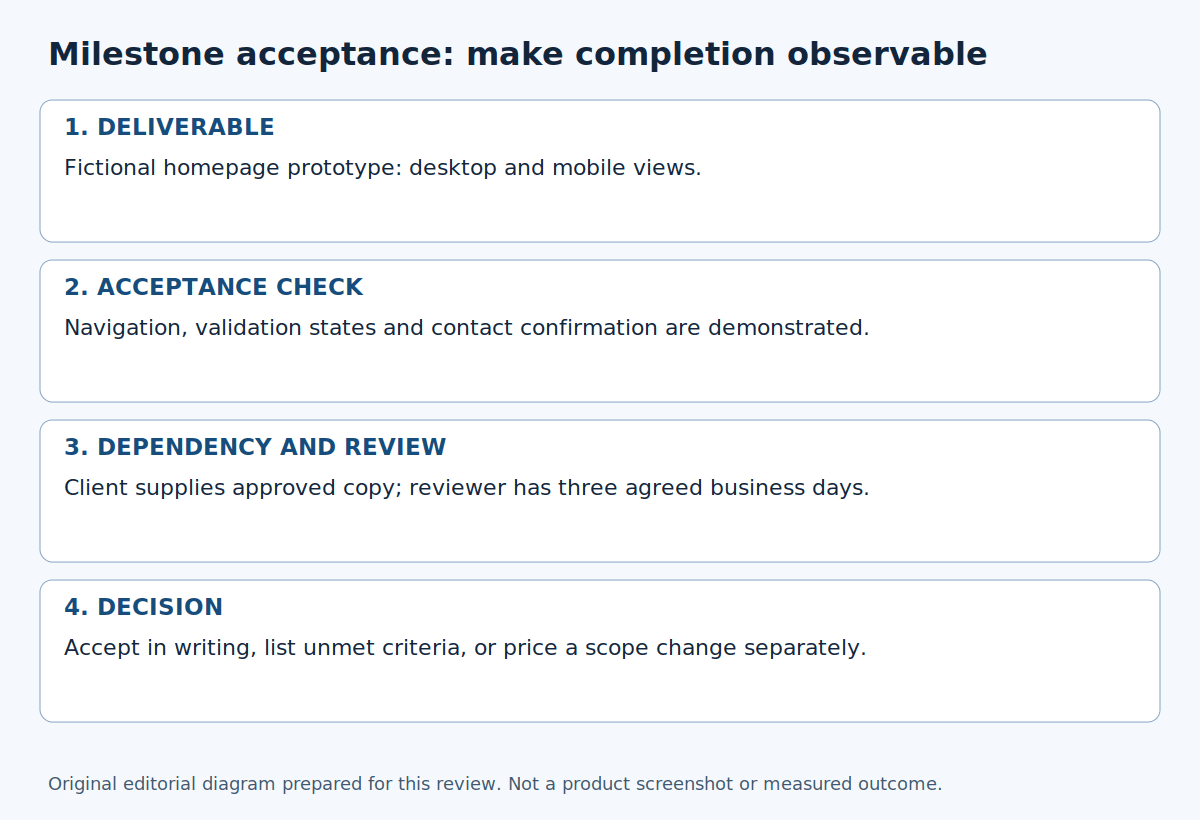
Freelance Project Milestones and Acceptance Criteria
Define reviewable deliverables, acceptance tests and dependencies. Use a fictional milestone table to plan feedback, changes and handoff.
Read more
How to Get Clients: Build a Relationship Before Asking for Work
Learn how to get clients through genuine conversations, relevant outreach, respectful follow-ups, and a professional profile that shows your work.
Read more
Comments (0)
Sign in to join the discussion.
No comments yet. Start the conversation.