
Article
How to Write CV Achievement Bullets Without Inventing Numbers
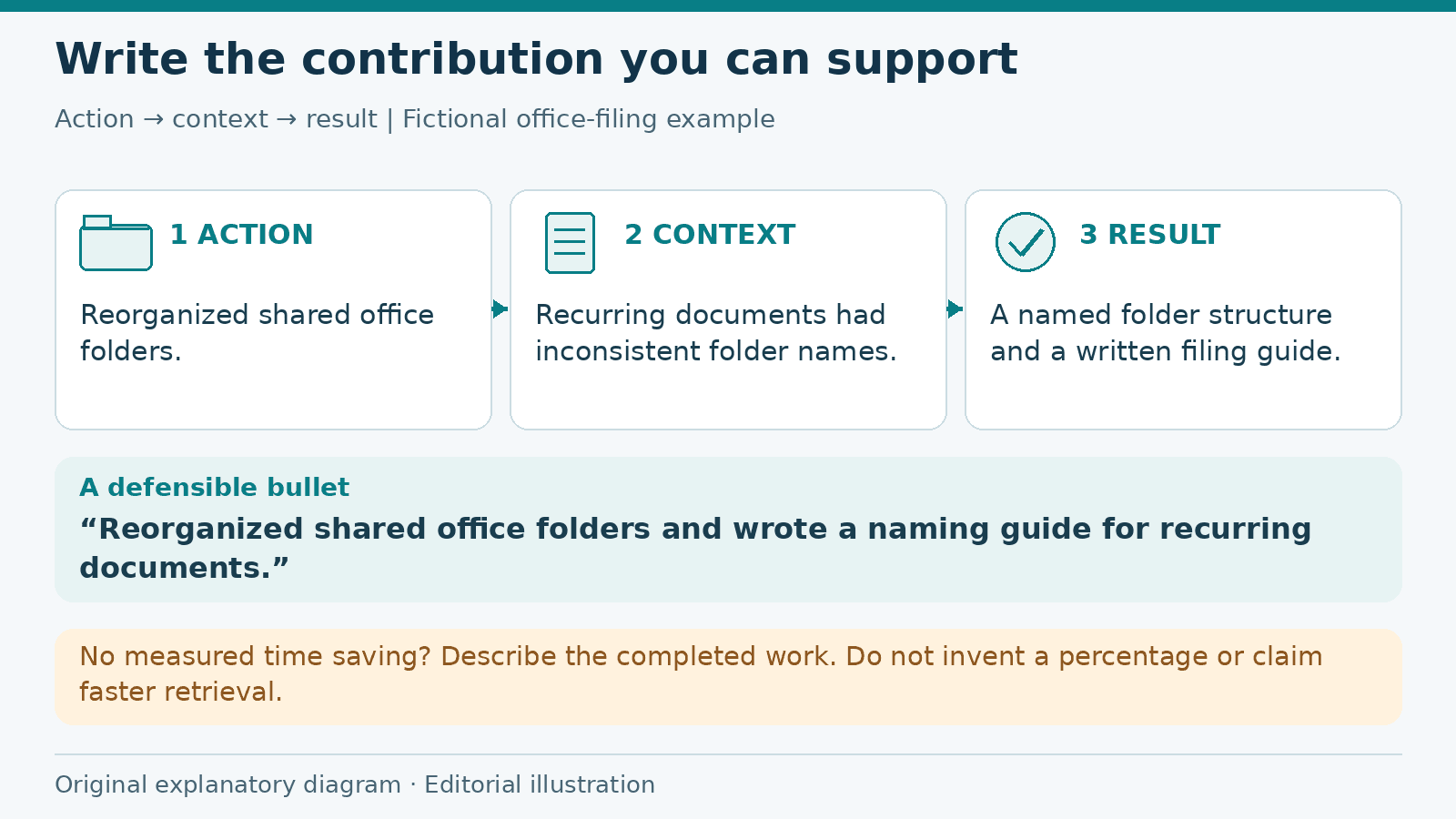
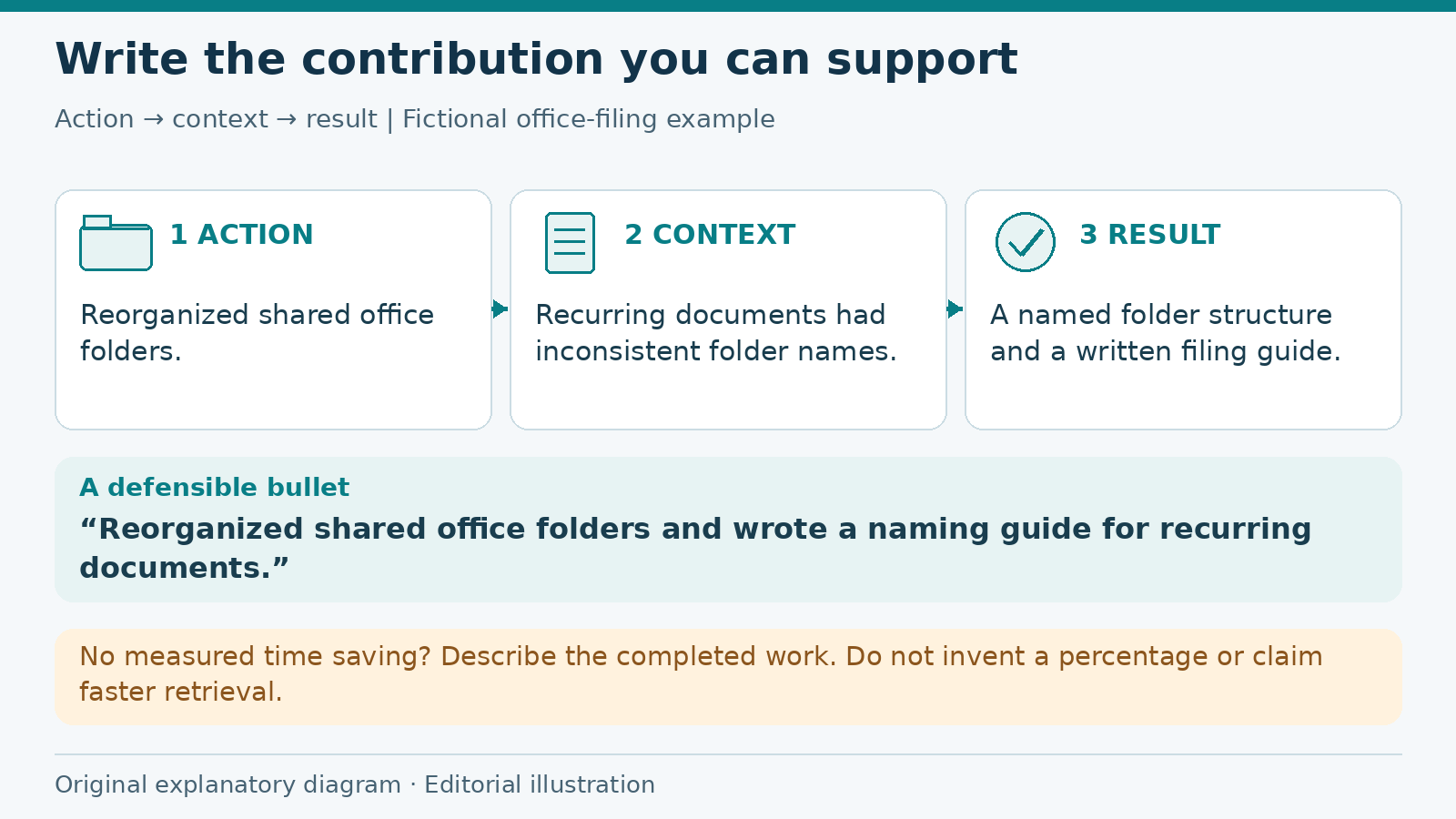
Fictional example: use action, context and a supported qualitative result; do not invent a metric. Original operator-created explanatory diagram; not a product screenshot or ATS test. Drawn from original shapes and text without third-party image assets.
CV achievement bullets can show what you contributed even when your workplace did not track exact results. You do not need a percentage for every task. You do need enough detail for an employer to understand the work and enough evidence to explain it honestly in an interview.
Start with a task you remember clearly: organizing office files, handling a difficult customer enquiry or checking a batch of components. Describe your part in it. Then add the result you can support, rather than the result you wish someone had measured.
Turn a duty into a specific contribution
A duty tells the reader what your role covered. An achievement bullet explains something you did within that role. It may describe a finished report, a clearer handover or a problem you identified. It need not be an award or a company-wide improvement.
For example, replace “Responsible for answering customer questions” with “Explained service procedures to customers and coordinated complex enquiries with specialist teams.” The second version tells the reader how the work happened. It does not pretend that the candidate measured customer satisfaction.
All sample bullets below are fictional writing examples, not claims about the author or real applicants. Adapt the approach to your own experience; do not copy an outcome you cannot substantiate.
Use action, context and result
Build a draft around what you did, the situation and what happened. Princeton's accomplishment-statement guidance uses a similar structure. Santa Clara University's guide also asks writers to connect an action with its context and result.
- Action: organized shared office documents.
- Context: colleagues used inconsistent folder names for recurring work.
- Result: the team had a named folder structure and a written filing guide.
A possible bullet is: “Reorganized shared office folders and wrote a naming guide for recurring documents.” That is enough if those are the facts you can confirm. Add “reduced time spent searching” only if you have evidence of that change. A useful intention is not automatically a measured result.
The structure is a drafting aid, not a rule for every sentence. If a bullet reads awkwardly, shorten it. One clear contribution is better than a long sentence that tries to include every stage of a project.
Look for evidence before adding claims
Review records you are allowed to access: project summaries, performance feedback, training records or emails confirming a completed assignment. A process document you wrote can also help you recall exactly what changed. Do not download confidential material merely to support your CV.
Keep a private note beside each draft bullet explaining where the information came from. This note does not belong in the application. It helps you separate a clear memory from a guess, and prepares you to answer questions later.
Ask what you personally handled. If you supported a team, describe that contribution rather than taking credit for the team's entire result. “Documented outstanding tasks for the project handover” is more accurate than “Delivered the project” when you did not own its delivery.
Describe outcomes without forcing a number
Qualitative outcomes still need evidence. A completed guide, a documented inspection or an agreed handover is concrete. “Transformed operations” tells the reader little and may imply much more than you did.
If you cannot confirm that a process improved, describe the output or action instead. For instance, “Recorded component defects and sent inspection findings to the quality team” does not claim that defects disappeared. It shows the candidate's contribution without guessing at the later business result.
Useful questions include: What did I finish? What did colleagues use? Which problem did I flag? What feedback did I receive? Choose the answer you can explain with a real example.
Before-and-after examples for different roles
Customer support
Before: “Helped customers and solved problems.”
After: “Guided customers through service procedures, clarified their concerns and escalated issues requiring specialist support.” This names the actions without inventing a resolution rate.
Administration
Before: “Did office work and maintained files.”
After: “Updated administrative records and applied consistent file names to shared documents.” If easier retrieval was not checked, leave that claimed benefit out.
Quality control
Before: “Checked products and maintained quality.”
After: “Inspected components against approved specifications and documented non-conformities for review.” Use the actual term from your workplace only if it describes what you did.
Sales
Before: “Worked in sales and talked to clients.”
After: “Explained product options to prospective customers, recorded their requirements and coordinated follow-up calls.” This shows sales work without claiming revenue growth.
Education and teamwork
Before: “Completed a college project.”
After: “Researched the assigned topic and presented findings in a structured project report.” For a group assignment, identify your part: research, analysis, writing or presentation. Do not present everyone else's work as your own.
Likewise, replace “Worked well with colleagues” with an observable action, such as “Recorded task updates and outstanding questions for shift handovers.”
Work through an office-filing example
Imagine a fictional office assistant who reorganized folders and standardized file names. Nobody measured how long document searches took before or afterward. The assistant can confirm that the folder structure changed and that colleagues received the naming guide.
A defensible bullet is: “Reorganized shared folders by subject and prepared a file-naming guide for office staff.” An unsupported version would be: “Cut document retrieval time by half.” The second sentence invents a measurement the assistant does not have.
Before using the first version, the candidate should be able to explain the previous arrangement, the changes made and their own responsibility. If asked about time savings, they can say the team did not measure them. There is no need to replace missing evidence with a confident-sounding estimate.
Check numbers, ownership and confidentiality
Include numbers when they are relevant and verifiable. Check the source, period and meaning of each figure. If it describes a team result, explain your role. If it is an estimate, you need a defensible basis and wording that makes the uncertainty clear.
A documented project size can be useful even when you do not have a performance metric. But knowing how many files existed does not establish how much time your work saved. Do not turn one kind of evidence into another.
Remove private customer details, internal financial figures and proprietary processes you cannot disclose. Use a general description such as “a corporate client” when appropriate, while keeping the underlying experience truthful. Anonymizing a project is not permission to invent one.
Review the bullets in your complete CV
Read the bullets alongside the vacancy. Keep the examples that show relevant skills and remove repeated claims. Choose accurate verbs: “supported” may be right when “led” is not.
You can arrange your draft in the ALHarih Resume Builder, which advertises browser-based editing and PDF download. Review the exported file as well as the editor. A builder can present your words, but it cannot verify your employment history or achievements.
Checklist before you apply
- Each bullet describes a specific action you took.
- The context helps explain why the work mattered.
- Any claimed outcome has supporting evidence.
- Numbers have a reliable source and a clear timeframe.
- Your contribution is distinct from the team's overall result.
- Confidential details have been removed.
- The wording fits the vacancy without borrowing skills you do not have.
- You can explain every statement in an interview.
Choose a few relevant tasks and rewrite them using this method. For help arranging the finished document, read the ALHarih CV builder guide or browse the articles library.
Read next
View all articles
How to Learn German Without Getting Lost in Grammar
Learn German with useful phrases, grammar examples, listening practice and a simple daily routine that helps you start speaking without waiting for perfection.
Read more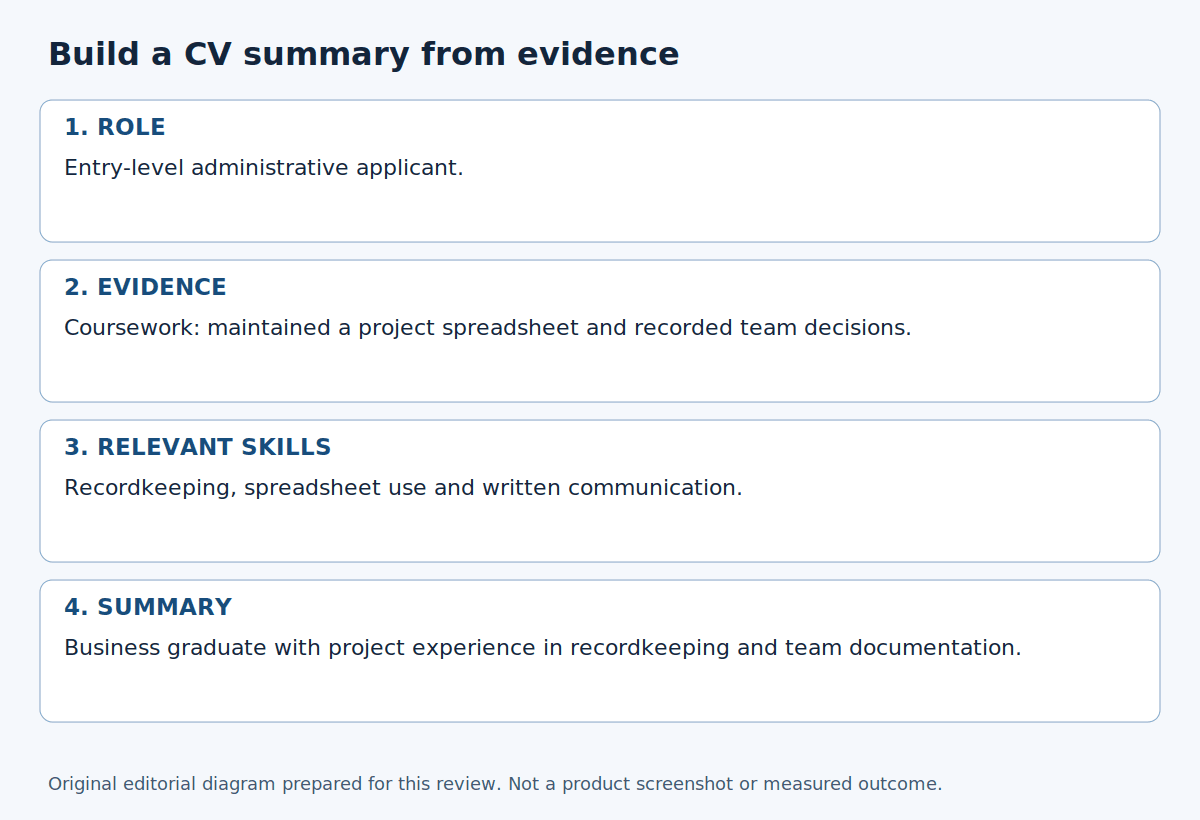
How to Write a Professional CV Summary with Examples
Write a concise CV introduction grounded in real experience. Compare six hypothetical summaries and replace empty claims with specific evidence.
Read more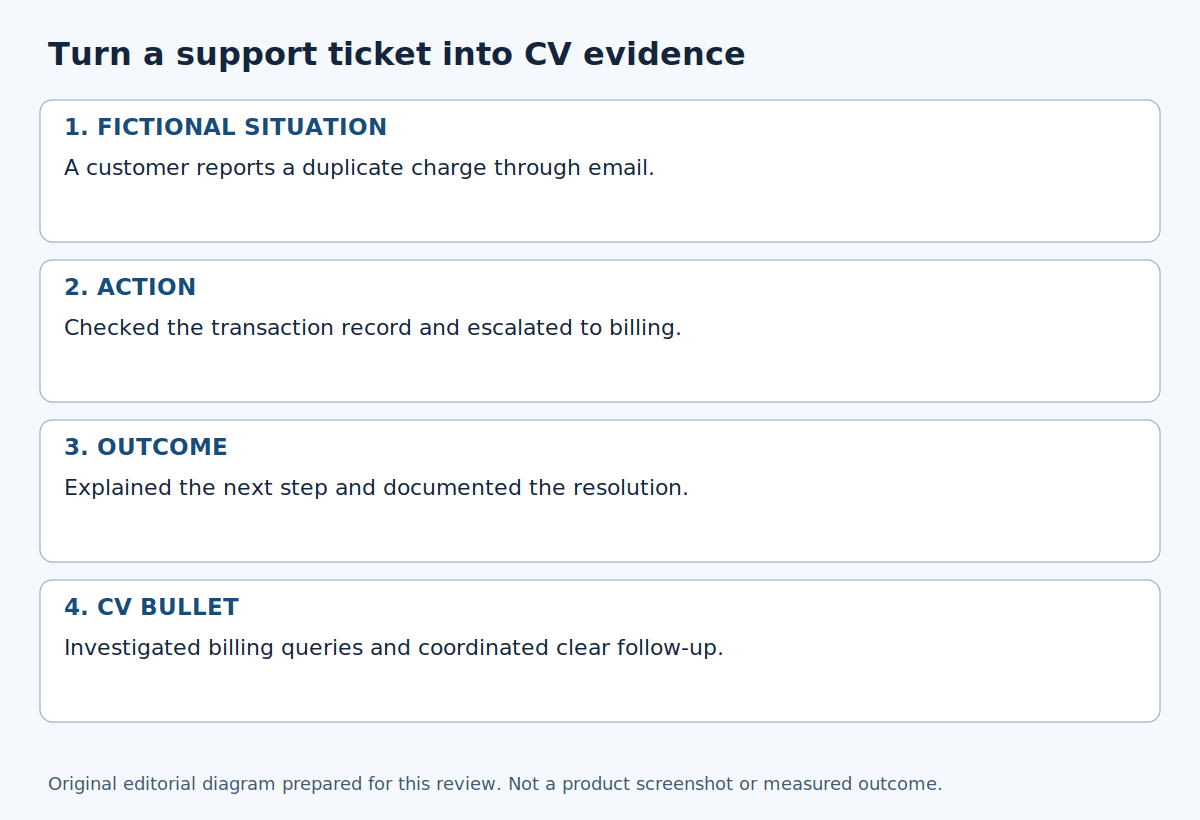
How to write a customer support CV with clear examples
Show what you did when customers needed help. Use clear CV examples, accurate tool descriptions and supportable outcomes without exposing private records.
Read moreExplore related career opportunities
Find roles that fit your location and interests. Each listing explains its current or planned vacancies.
All locations, roles and employment types
Comments (0)
Sign in to join the discussion.
No comments yet. Start the conversation.