
Article
How to Learn Spanish One Real Conversation at a Time
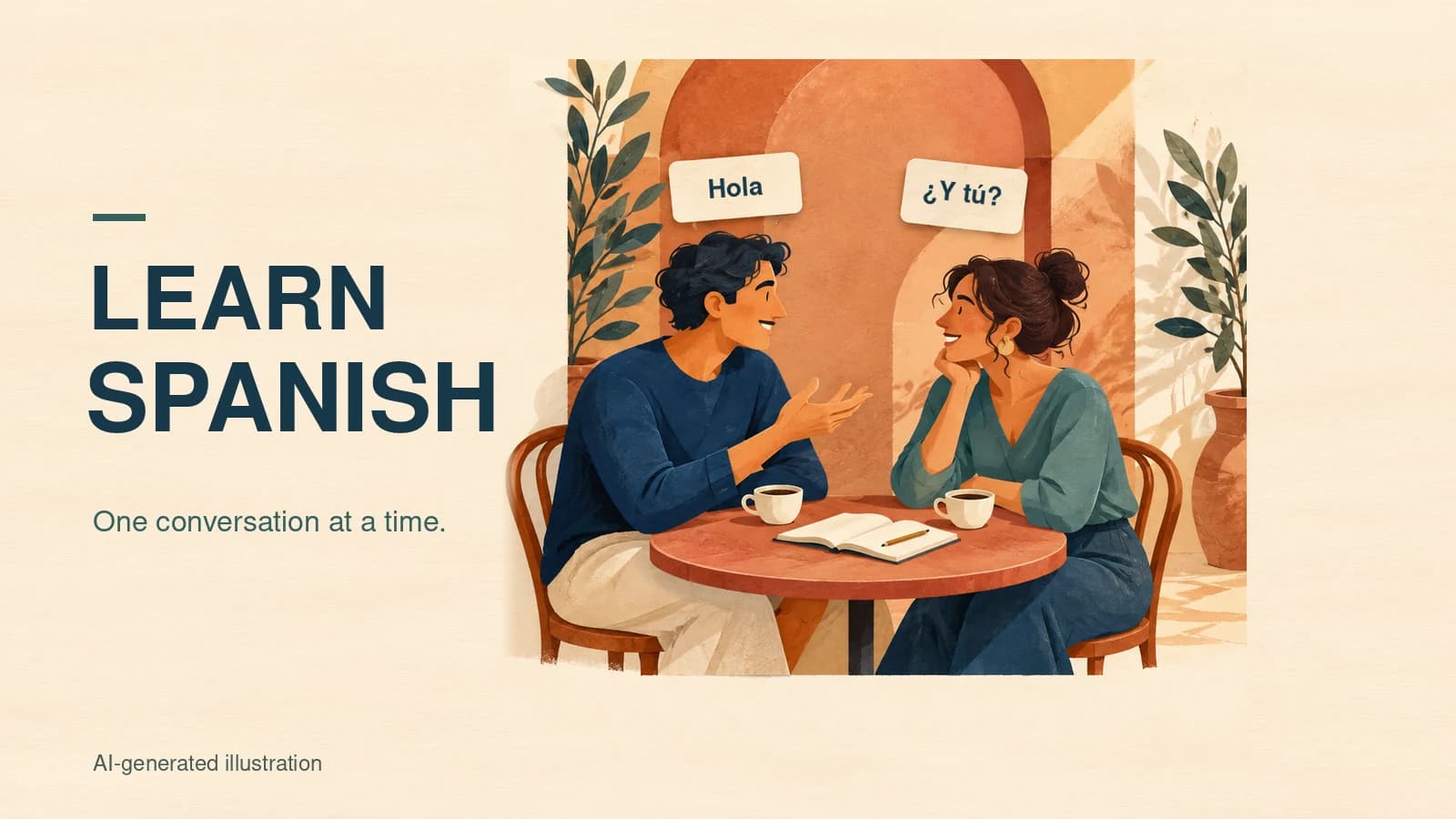
Imagine this.
You have learned hola. You can say your name. You have practiced ordering a coffee, and your pronunciation sounds reasonably convincing when nobody else is listening.
Then someone replies in Spanish.
Suddenly, your brain closes every open tab.
You recognize a word near the beginning. Possibly another one near the end. Whatever happened in the middle is now a matter for further investigation.
That is a frustrating moment. But it does not mean you cannot learn Spanish. It gives you something specific to work on: understanding a reply and responding without a prepared script.
If you want to learn Spanish, start building those small exchanges instead of waiting until you feel ready for a perfect conversation.
Learn the reply, not just the opening line
An introduction is useful. But a conversation has another person in it, which is where your carefully rehearsed plan can become less cooperative.
Practice short exchanges rather than isolated sentences.
For example:
¿Cómo te llamas? — What is your name?
Me llamo Alex. ¿Y tú? — My name is Alex. And you?
Or:
¿Hablas español? — Do you speak Spanish?
Un poco. Estoy aprendiendo. — A little. I am learning.
These examples use informal address, suitable for someone you are speaking to on a tú basis.
Change the name. Try the question first. Answer without looking. Then practice hearing the question rather than only reading it.
Your goal is to take part in the exchange, not just deliver your line and hope the other person leaves.
Give yourself a way to get unstuck
You will meet words you do not know. Prepare for that instead of treating every unfamiliar sentence as the end of the conversation.
Keep a few useful phrases ready:
- No entiendo. — I do not understand.
- ¿Puedes repetirlo, por favor? — Can you repeat it, please?
- ¿Puedes hablar más despacio, por favor? — Can you speak more slowly, please?
- ¿Qué significa esta palabra? — What does this word mean?
The two requests with puedes also use informal address.
These are not embarrassing emergency supplies. They are tools for staying involved.
You do not need to pretend you understood something. Asking a useful question is part of communicating too.
Collect language you can actually use
Knowing the Spanish word for an unusual animal might help you win a very specific quiz.
It may be less helpful when you are trying to explain that you need water.
Build vocabulary around situations that matter to you: introducing yourself, buying food, discussing work, asking for directions or talking about your day.
Then learn words inside short phrases:
- Quiero aprender español. — I want to learn Spanish.
- Necesito ayuda. — I need help.
- Quisiera un café, por favor. — I would like a coffee, please.
Learn nouns with their articles too. For example, el libro means “the book” and la mesa means “the table.”
Rather than guessing an article every time you speak, practice it with the word from the beginning.
You do not need the largest vocabulary in the room. Start with vocabulary that lets you do something.
Take grammar in useful pieces
Spanish grammar deserves your attention. It does not need to receive your entire weekend before you say another sentence.
Consider these examples:
Soy estudiante. — I am a student.
Estoy en casa. — I am at home.
English uses “am” in both. Spanish uses forms of different verbs: ser and estar.
Here, soy identifies a role, while estoy describes location. That is a useful contrast to practice, not a complete explanation of every use of these verbs.
Be careful with shortcuts such as “ser is permanent and estar is temporary.” They are not reliable rules for every situation.
Learn examples, notice the context and ask why a particular form is used. You can build a more detailed understanding as you encounter more sentences.
Grammar becomes easier to work with when it explains language you are already trying to use.
Train your ears without overwhelming them
A recording you barely understand can be difficult to learn from without support. Choose something short enough to revisit and clear enough to work with.
Try a simple process:
- Listen without reading and notice what you recognize.
- Read the transcript and check the meaning.
- Listen again while following the words.
- Pause after a useful sentence and repeat it aloud.
- Try saying that sentence without the recording.
You do not have to extract every possible lesson from one clip. Take a useful phrase and practice using it in a slightly different situation.
Pay attention to sound as well as meaning. In hola, for example, the h is silent. Copying English spelling habits will not always give you the Spanish pronunciation.
Listen to a model, make your attempt and compare. Understandable speech is a sensible target; you do not need to perform a new identity along with your new vocabulary.
Do not turn accents into another reason to delay
You may hear a word pronounced differently by speakers from different places. You may also encounter different vocabulary for the same thing.
Spanish has regional variation. You do not need to solve all of it before introducing yourself.
Choose a consistent starting point through a teacher, course or set of recordings. If you expect to communicate mainly with people from a particular place, let that guide your initial examples.
That is a practical choice, not a declaration that everyone else speaks incorrectly.
You can broaden your listening as you progress.
Use tools without outsourcing your practice
A dictionary can help you check a word. A teacher can explain a confusing pattern. An AI conversation tool can give you another opportunity to attempt an exchange.
But do not let assistance replace your own effort.
For a practice prompt, you could use:
Help me practice a beginner Spanish conversation in a café. Ask one short question at a time and wait for my answer. Keep the vocabulary simple. Correct one important mistake after each reply and explain it in English.
Treat generated corrections as something to check, especially when an explanation conflicts with your course or a teacher's guidance.
And answer before asking the tool to write your response.
Otherwise, you may become very good at watching software speak Spanish. That is a different skill.
Build a routine around a small task
Instead of deciding to “study Spanish” and then spending the whole session choosing a resource, pick a task in advance.
Try a flexible 15-minute session:
- Five minutes: Listen to and repeat a short exchange.
- Five minutes: Perform a similar exchange aloud, changing some details.
- Five minutes: Write down what you could not say, check it and try again.
This is a suggested practice structure, not a guaranteed route to fluency within a particular deadline. Adjust it to your time, needs and other lessons.
On a busy day, a smaller task is fine. You can return to the same conversation rather than constantly looking for something new.
Revisiting an awkward exchange gives you another chance to make it less awkward.
Notice the moments when Spanish becomes useful
Can you answer a familiar question without translating every word first?
Can you ask for clarification instead of switching immediately to English?
Can you change a practiced sentence to say something you actually mean?
Those are useful things to notice alongside lessons completed and vocabulary reviewed.
Your progress does not have to look impressive on a screenshot to matter in a conversation.
You will hesitate. You will forget a word you knew yesterday. Occasionally, a reply will still make your brain close every open tab.
Ask the person to repeat it. Find the part you understand. Try your next sentence.
You do not need to wait until you can speak Spanish perfectly. You need opportunities to use the Spanish you have.
Start with one real exchange. Then give yourself another.
Read next
View all articles
How to Learn German Without Getting Lost in Grammar
Learn German with useful phrases, grammar examples, listening practice and a simple daily routine that helps you start speaking without waiting for perfection.
Read more
Freelance Project Milestones and Acceptance Criteria
Define reviewable deliverables, acceptance tests and dependencies. Use a fictional milestone table to plan feedback, changes and handoff.
Read more
Binance Hack 2026: What Happened and Why It Matters
The Binance hack in October 2026: what Binance has confirmed, how signing systems can be abused, and practical security lessons for developers and users.
Read more
Comments (0)
Sign in to join the discussion.
No comments yet. Start the conversation.