
Article
How to compare freelance proposals with a scorecard
To compare freelance proposals, start with what each person has actually offered. A low fee may exclude research or revisions. A short delivery estimate may depend on you supplying material first. A persuasive introduction may have little evidence behind it.
A scorecard puts the same questions beside every proposal. It helps you record the trade-offs rather than rely on memory. The numbers still reflect judgment; they do not predict which freelancer will perform best. The weights, candidates, prices and ratings in this guide are fictional editorial examples.
Set the must-haves before awarding points
Write down the scope, deliverables, budget, deadline and acceptance conditions. For a set of articles, specify the audience, length, source expectations and delivery files. For a website, identify required pages, integrations and testing. A candidate cannot give a comparable quote for work you have not defined.
Separate essential conditions from preferences. A required technical capability or an immovable deadline may be a must-have. Familiarity with your industry might be useful but negotiable. Check essentials first so a high score in other areas cannot hide a disqualifying problem.
For example, a strong portfolio cannot compensate for availability after your launch date if that date truly cannot move. Ask whether the conflict can be resolved before rejecting the proposal. Record the answer rather than quietly changing the requirement for a favourite candidate.
Use six criteria you can explain
Keep the scorecard small enough to use. For each criterion, write a short evidence note alongside the rating.
- Skills and experience: Which relevant sample can you inspect, and what did the freelancer personally contribute?
- Project understanding: Does the proposal address your audience, constraints and unanswered questions?
- Price and value: What does the total quote include, and which costs remain outside it?
- Timeline: Are delivery dates realistic, and what must happen before work can start?
- Communication: Are answers clear, and does the proposed update schedule suit both sides?
- Deliverables and risk: Are final files, revisions, acceptance checks and unresolved assumptions defined?
A fictional $300 quote and a $400 quote are not comparable until you know what each buys. The cheaper quote might omit editing; the higher one might include it. Equally, a higher fee is not proof of better work. Normalize the scope before scoring value.
Do not reward instant replies automatically. Compare communication against an agreed working schedule and the project's needs, including time zones. Avoid counting the same strength repeatedly across portfolio, experience and project understanding without a reason.
Choose weights before reviewing the totals
The following allocation gives more points to relevant experience and understanding than to price alone. It is a starting example, not a universal hiring formula. Agree your own priorities before you see which candidate they favour.
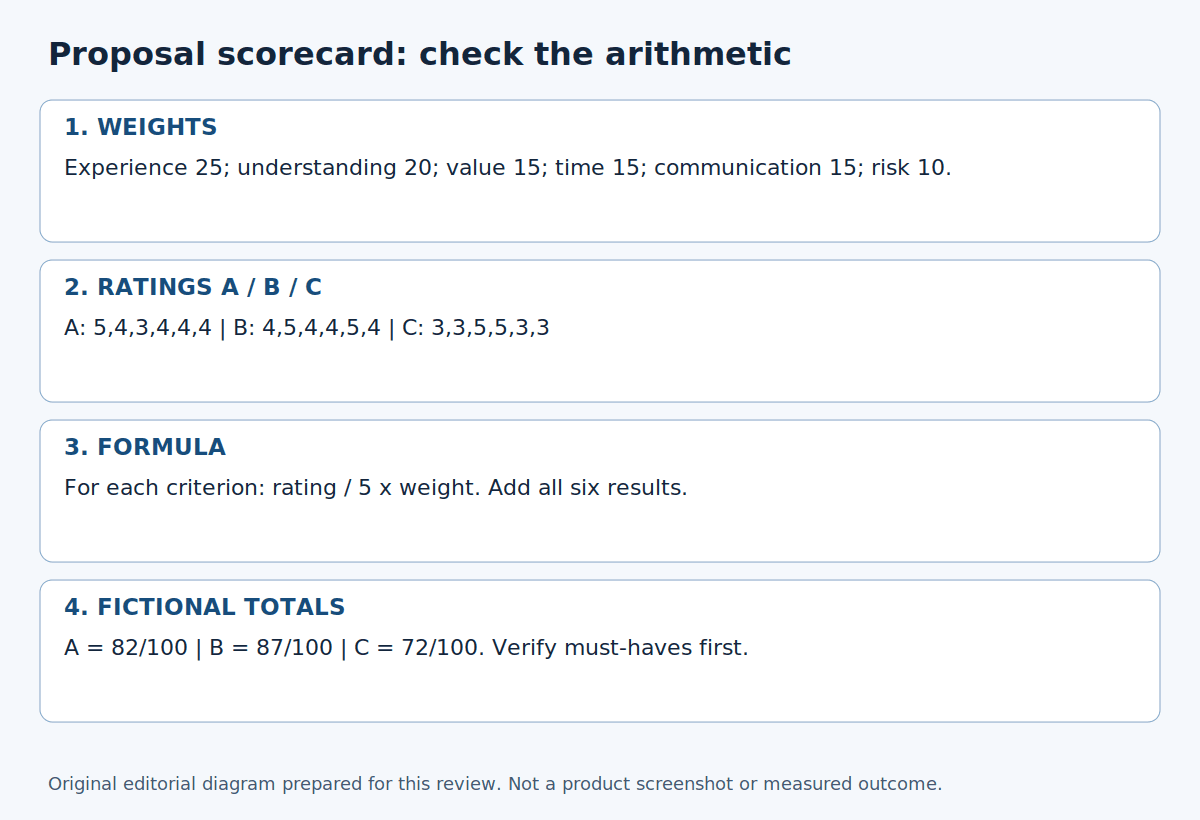
| Criterion | Weight in points |
|---|---|
| Skills and experience | 25 |
| Project understanding | 20 |
| Price and value | 15 |
| Timeline | 15 |
| Communication | 15 |
| Deliverables and risk | 10 |
| Total | 100 |
Use the same rating scale for everyone:
- 1: The evidence shows the requirement is not met.
- 2: There are significant weaknesses.
- 3: The proposal meets the basic requirement.
- 4: There is strong evidence of fit beyond the minimum.
- 5: The evidence shows an especially close fit for this project.
Write a project-specific explanation of what a 3 or a 5 means where needed. For timeline, a 5 should mean a credible plan that fits your schedule, not simply the shortest promise. Mark missing evidence as unverified and ask for clarification before assigning a final rating.
Calculate each contribution using: weighted points = (rating ÷ 5) × criterion weight. A rating of 4 on a 25-point criterion earns (4 ÷ 5) × 25 = 20 points. Add all six contributions for a total out of 100.
Worked example: compare three article-writing proposals
Suppose three fictional freelancers respond to the same article brief. The table shows ratings, not weighted points, until the final row. These are invented assessments to demonstrate the calculation, not records of real candidates or measured hiring results.
| Criterion | Weight | A rating | B rating | C rating |
|---|---|---|---|---|
| Skills and experience | 25 | 5 | 4 | 3 |
| Project understanding | 20 | 4 | 5 | 3 |
| Price and value | 15 | 3 | 4 | 5 |
| Timeline | 15 | 4 | 4 | 5 |
| Communication | 15 | 4 | 5 | 3 |
| Deliverables and risk | 10 | 4 | 4 | 3 |
| Weighted total out of 100 | 100 | 82 | 87 | 72 |
A earns 25 + 16 + 9 + 12 + 12 + 8 = 82. B earns 20 + 20 + 12 + 12 + 15 + 8 = 87. C earns 15 + 12 + 15 + 15 + 9 + 6 = 72.
B ranks first under these assumptions. C's high price-and-value and timeline ratings do not outweigh the lower ratings elsewhere. Before choosing B, check the work samples, availability and unresolved terms that support those numbers. A score of 87 is not an 87% probability of success.
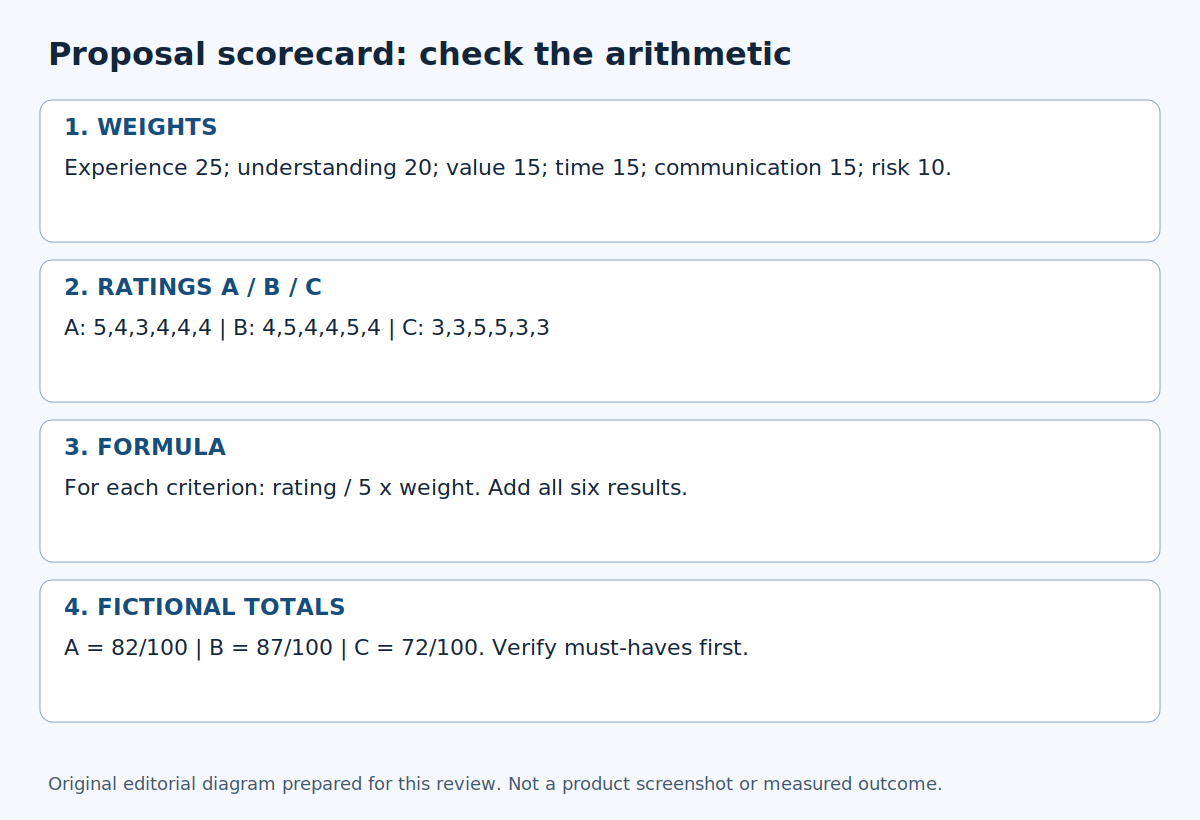
Original explanatory diagram generated for this editorial correction; not a product screenshot. The diagram contains no copied image assets. Source: this article’s worked example. No third-party image licence is asserted.
Ask questions that can change the decision
Send shortlisted candidates the same core questions, with specific follow-ups where necessary:
- Which deliverables and file formats are included in the quote?
- What research, testing or editing is included?
- How many revision rounds are included, and what counts as new scope?
- What materials, access or decisions do you need from the client?
- Which milestone dates depend on those inputs?
- What did you personally do in the portfolio sample?
- Which assumptions could change the fee or schedule?
Clarify ownership, confidentiality, payment milestones and any post-delivery support in the written terms. A scorecard cannot establish legal rights by itself. If a small paid test would answer a specific question, agree its scope, fee and intended use first. Do not use candidate evaluation as a way to obtain substantial unpaid work.
Check whether the ranking depends on your assumptions
A small lead may reflect rating uncertainty rather than a meaningful difference. Ask another reviewer to score independently, then compare the evidence behind disagreements. Do not average away an unresolved must-have problem.
Try a reasonable alternative weighting and see whether the ranking changes. For example, move five points from skills and experience to price and value, leaving the total weight at 100. In this fictional example, A then scores 80, B remains at 87 and C rises to 74. B still leads. That checks one possible trade-off; it does not prove the ranking is robust under every set of priorities.
The Government Analysis Function introduction to multi-criteria decision analysis discusses formal ways to compare options. HM Treasury's options-appraisal guidance explains sensitivity analysis. This freelance worksheet is a simplified editorial aid, not a validated prediction model or a claim of compliance with government procurement guidance.
Copy this worksheet
| Criterion | Weight | Rating, 1–5 | Weighted points | Evidence or question |
|---|---|---|---|---|
| Skills and experience | 25 | |||
| Project understanding | 20 | |||
| Price and value | 15 | |||
| Timeline | 15 | |||
| Communication | 15 | |||
| Deliverables and risk | 10 | |||
| Total | 100 | /100 |
With weights in B2:B7 and ratings in C2:C7, enter =B2*C2/5 in D2 and copy it through D7. Use =SUM(D2:D7) for the total. Make a separate worksheet or a clearly labelled set of columns for each candidate. Keep unverified items visibly unresolved rather than turning a blank into an unexplained zero.
Before you select a freelancer
- Confirm the same brief and scope were used for every quote.
- Check essential conditions before comparing preferences.
- Use consistent rating anchors and record evidence.
- Clarify missing costs, availability and dependencies.
- Recalculate totals and test a plausible change in weights.
- Review close scores as trade-offs, not precise performance forecasts.
- Agree scope, payment, revisions and acceptance checks in writing.
Use the freelance project brief guide to prepare your requirements before browsing the ALHarih talent directory. You can also read related ALHarih articles. A profile is a starting point for checking evidence, not proof of suitability or a guaranteed project outcome.
Read next
View all articles
How to Compare Freelance Proposals Beyond the Price
Choosing a freelancer based only on price can lead to disappointing results. Learn how to compare freelance proposals by evaluating experience, project understanding, communication, deliverables, deadlines, and overall value.
Read more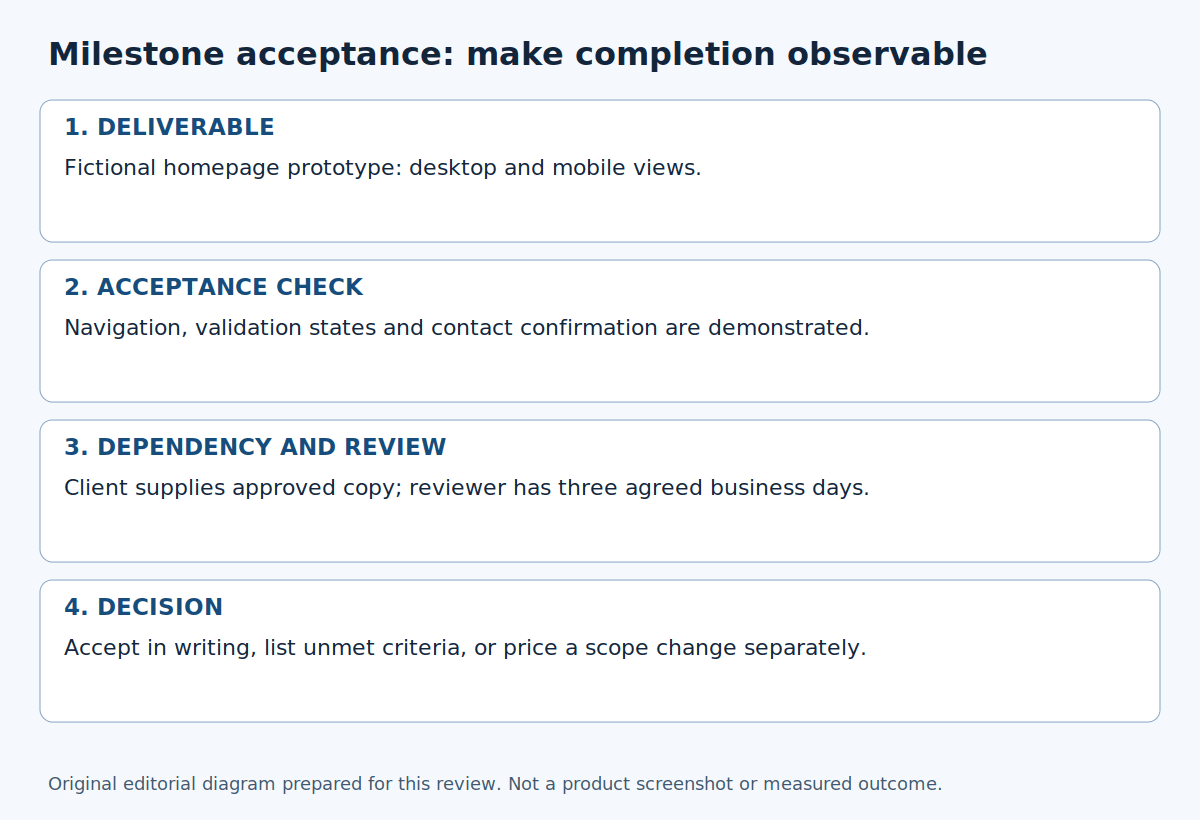
Freelance Project Milestones and Acceptance Criteria
Define reviewable deliverables, acceptance tests and dependencies. Use a fictional milestone table to plan feedback, changes and handoff.
Read more
How to Hire a Freelance Web Developer: An Evidence-Based Checklist
Learn how to hire a freelance web developer with confidence. Use this evidence-based checklist to evaluate portfolios, verify technical skills, compare proposals, assess security practices, and choose the right developer for your project.
Read more
Comments (0)
Sign in to join the discussion.
No comments yet. Start the conversation.